Measuring from photographs: a history
Measuring from photographs is almost as old as photography, and the difficulty has been the same since the start: a photograph's scale holds in one plane only. Anything nearer the camera is drawn larger, anything further away smaller. Before photography, and long beside it, finds were drawn, and the page begins there. It follows how archaeology has dealt with the problem, in the order it happened, beside the fields that met the problem first or wrote the most explicit rules: architecture and mapping, astronomy, radiology, anthropology, police and forensic photography, biology, the standards for digitising cultural heritage, and the rules for stating how certain a measurement is. It ends with what the dates show across the fields, archaeology's place among them, what is settled, what is still open, and where PHOTARCH stands.
Before the photograph: drawings, measures and stated reductions
Before photography, and long beside it, finds were drawn, and their exactness came less from instruments than from measurement. A paper read in 1749 and printed in the first volume of Archaeologia (1770) gives an object's measurements in inches and its picture "reduced to the size of one fourth of the original" — the earliest stated reduction found. The Comte de Caylus's Recueil d'antiquités (1752–67) gives dimensions in the text and draws some objects at natural size; by Stephanie Moser's account he brought in a scale showing the objects' size, section profiles and more uniform reductions. In the Description de l'Égypte (1809–29) the plates of buildings carry scale bars in metres and toises, and the explanation of the plates concedes that the engraver altered several measurements, while the dimensions written on them are exact. The number in the text was worth more than the line on the plate.
The instruments helped with proportion, not with scale. In 1807 William Hyde Wollaston described the camera lucida, a prism through which the draughtsman sees the subject and the paper at once; the size of the drawing is set by placing the original at a proportionally greater distance than the paper, which holds only for a flat original at a known distance. The camera lucida had photography's plane problem built in, three decades before photography. No use of its predecessor, the camera obscura, in archaeological drawing has been found here; the camera lucida was the instrument. The pantograph, described by Christoph Scheiner in 1631, and squaring with a grid gave exact proportions, but only of flat originals. Tracings gave a full-size copy of a flat surface, and squeezes and plaster casts a mechanical one of relief: on Lepsius's Prussian expedition to Egypt (1842–45) paper squeezes were called "die treuesten Faksimile", the most faithful facsimiles, and painted walls were traced at full size and reduced in Berlin.
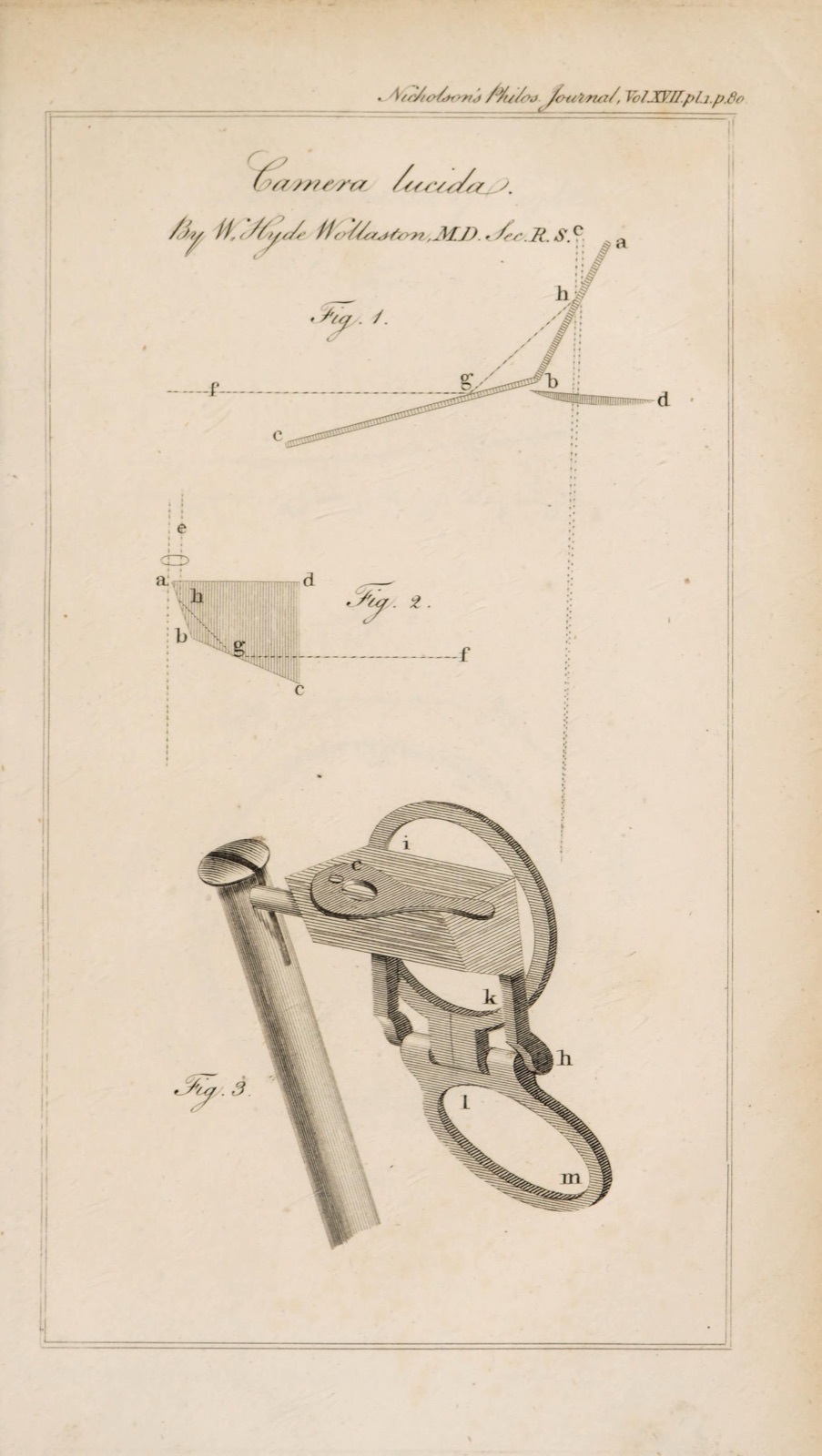
- THE PRISM — wollaston's, 1807: the eye over its edge sees the original and the paper
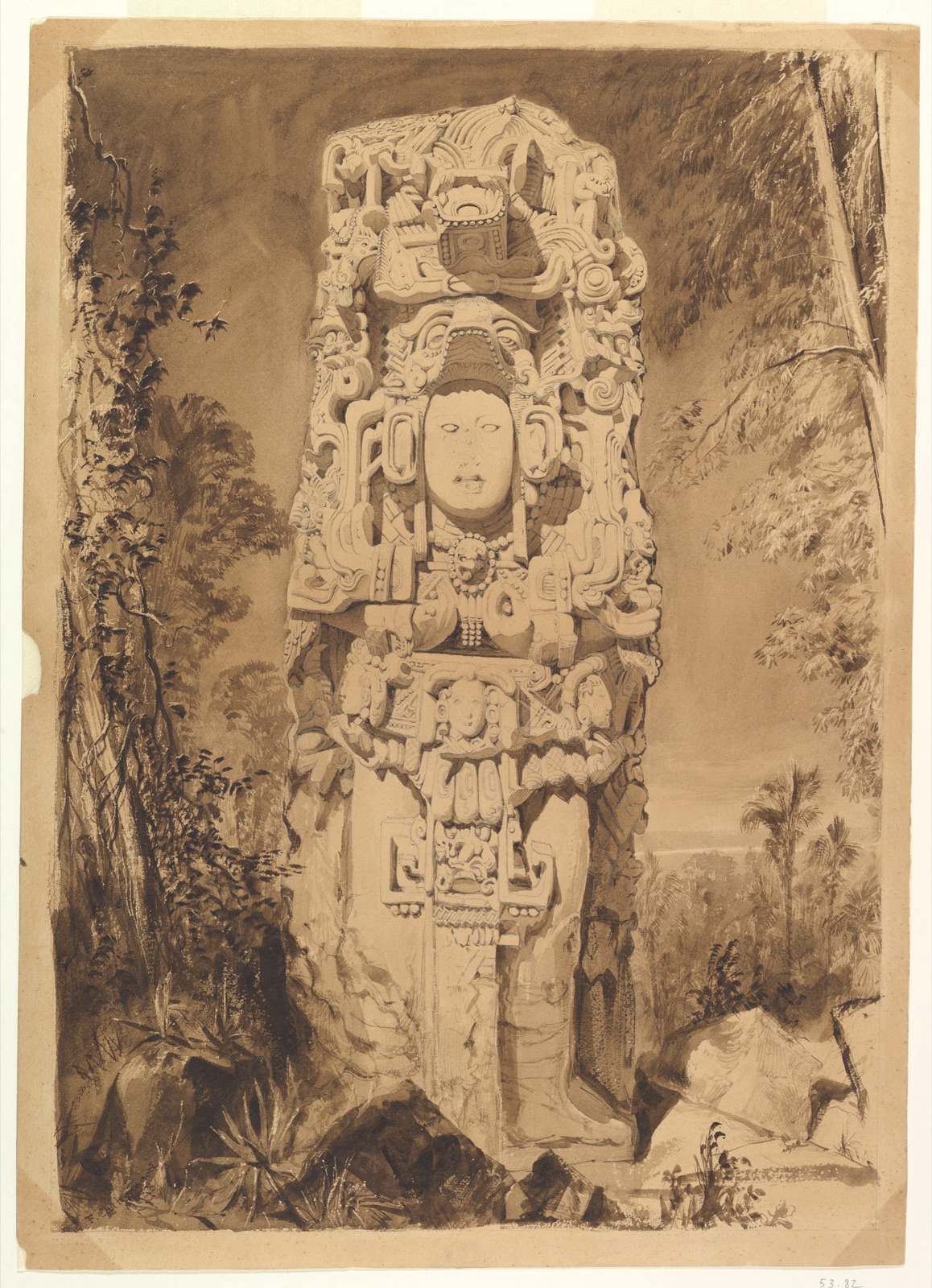
Frederick Catherwood had drawn in Egypt with Robert Hay in the 1820s and 1830s, where camera-lucida drawings, tracings straight from the wall and plaster casts were all used. He took the camera lucida to the Maya cities with John Lloyd Stephens. At Copán in 1839 he at first failed, "both with the camera lucida and without"; then he drew every outline with it, dividing his paper into sections to keep the proportions, and at Palenque scaffolds were built to hold the instrument. At Uxmal in 1841 they tried a daguerreotype camera; the results were "not sufficiently perfect", the parts in shadow lost, so Catherwood finished everything with pencil and camera lucida and the daguerreotypes went to the engravers as an aid. He reduced his drawings himself for engraving; woodcuts ordered in London were rejected as unlike the originals, and everything was engraved again on steel, Catherwood correcting the proofs. In his Views of Ancient Monuments (1844) six other lithographers redrew the views on stone, and one general view of Palenque is composed from separate sketches. The measurements travelled in the text; scale bars appear on a few plates only.
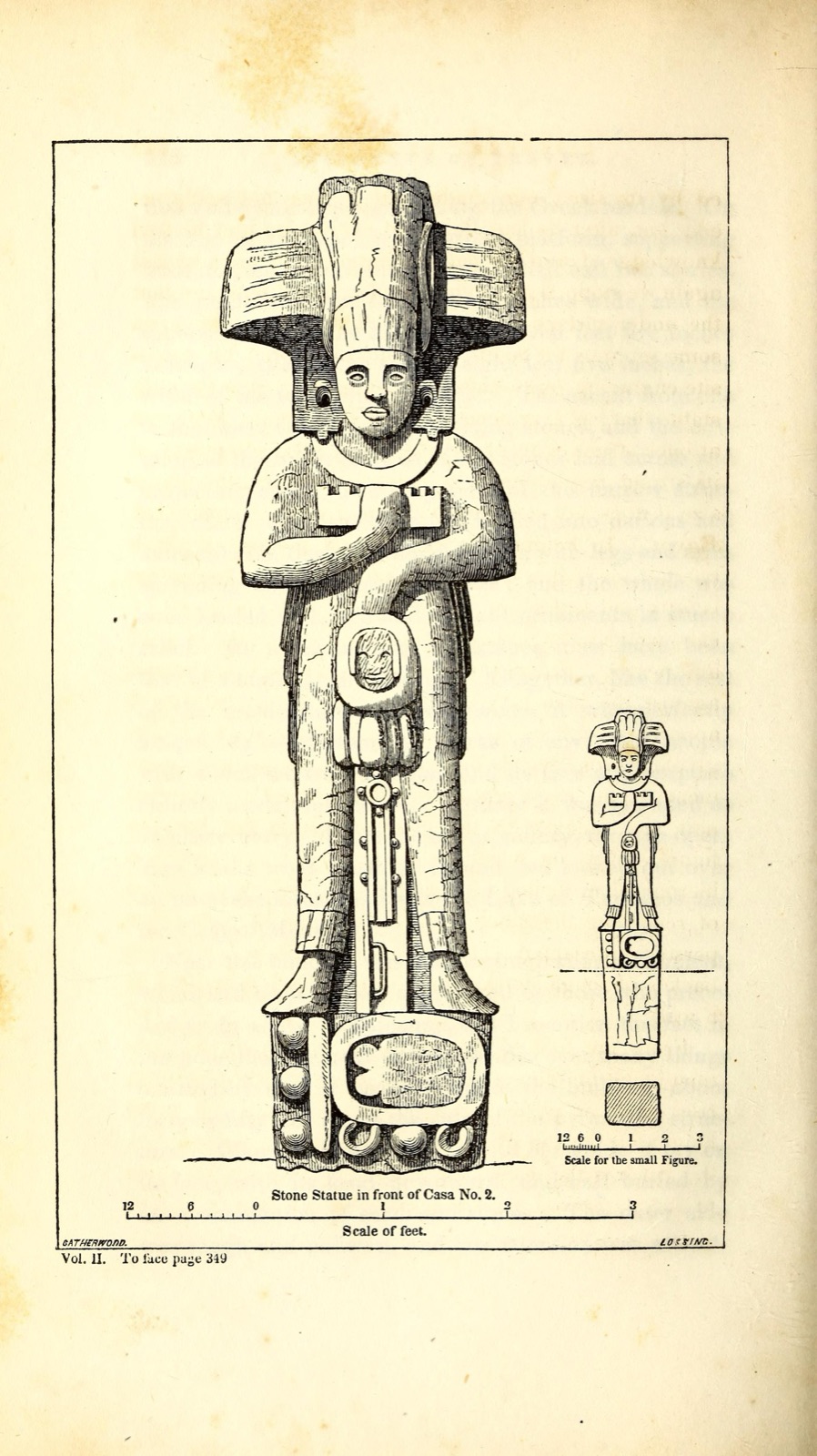
In Scandinavia the stated reduction became the rule for finds. Worsaae's catalogue of the Danish royal collection, the Afbildninger of 1854, drawn and etched by Magnus Petersen, gives a reduction beside every figure: ⅓, ½, 1/1. Oscar Montelius's books were illustrated by C. F. Lindberg, the Swedish Academy of Letters' draughtsman from 1867 to 1893 — Svenska fornsaker (1872–75), and Oluf Rygh's Norske Oldsager (1880–85) in Norway — and from 1874 by Olof Sörling, who made some sixty to seventy thousand drawings for Montelius, Hildebrand, Salin and Almgren. Both drew directly on the wood block, from which an engraver cut the printing block, and each figure carries its own reduction, chosen for the object: two flint axes on one page at ⅓ and ⅔. No source found says how they measured. Montelius held others to the convention: in 1885 he corrected a German publication whose figure was drawn not, as it claimed, at natural size, but at two thirds. Magnus Petersen, writing in 1909, held that photography would not do where form and measurement had to be exact in every detail, and in 1904 Petrie still called drawing "the main resource for illustration".
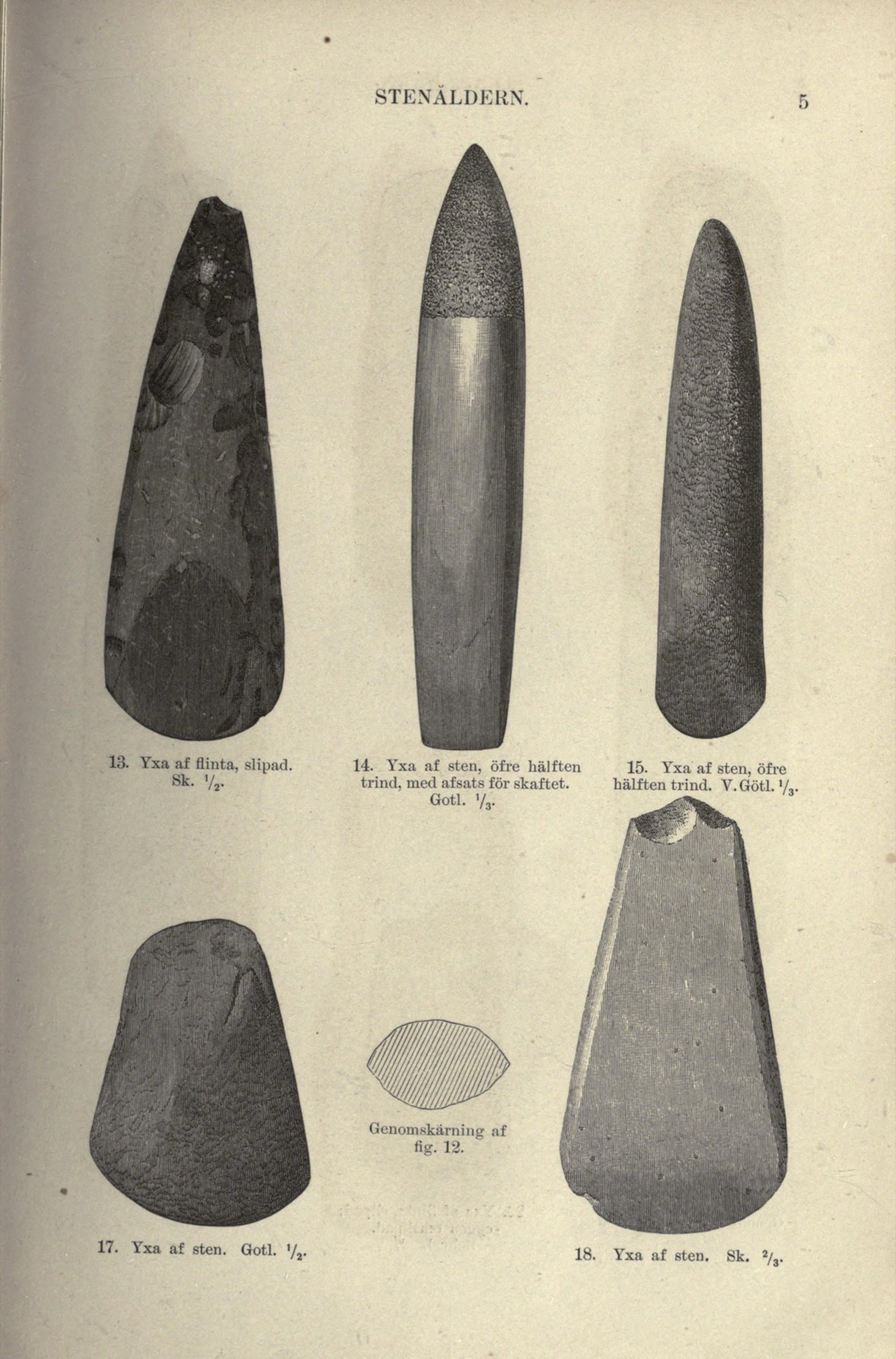
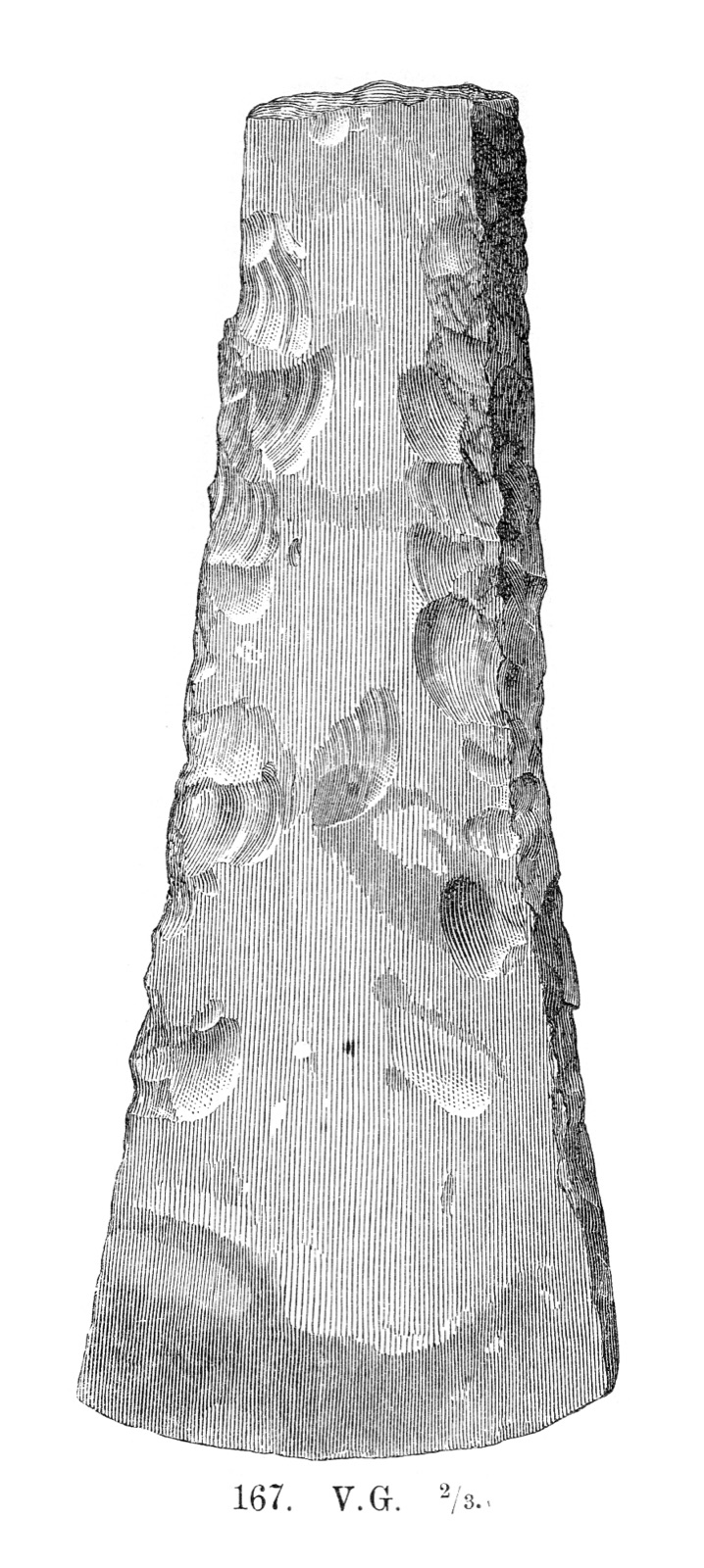
A reduction on a drawn plate means something different from one on a photograph. A figure marked ⅔ is a measured construction — outline, section, front and side — built from the object's dimensions, closer to a parallel projection than to a view from one point; Petrie's way of drawing the outline of a small object with an upright pencil around it on the paper gives a true outline. When photographs took over, they kept the drawn plates' way of stating the scale — the reduction in the caption — though no source found says the convention was handed on.
1850–1885: buildings, land and the first archaeological plans
In France, Aimé Laussedat drew plans from perspective views from 1850 and from photographs from 1861, fixing points by intersecting the rays from two camera stations. In Prussia the young architect Albrecht Meydenbauer had the same idea in 1858, without knowing of Laussedat's work. He built cameras for it in 1867 and wrote of photogrammetry in an architecture journal that December. His method worked only if the photographic plate stood strictly vertical: the orientation of the picture was controlled before anything was measured from it. In 1885 he founded the Messbildanstalt in Berlin, the first institution to document cultural heritage this way; until 1909 it also photographed Athens, Baalbek and Istanbul.
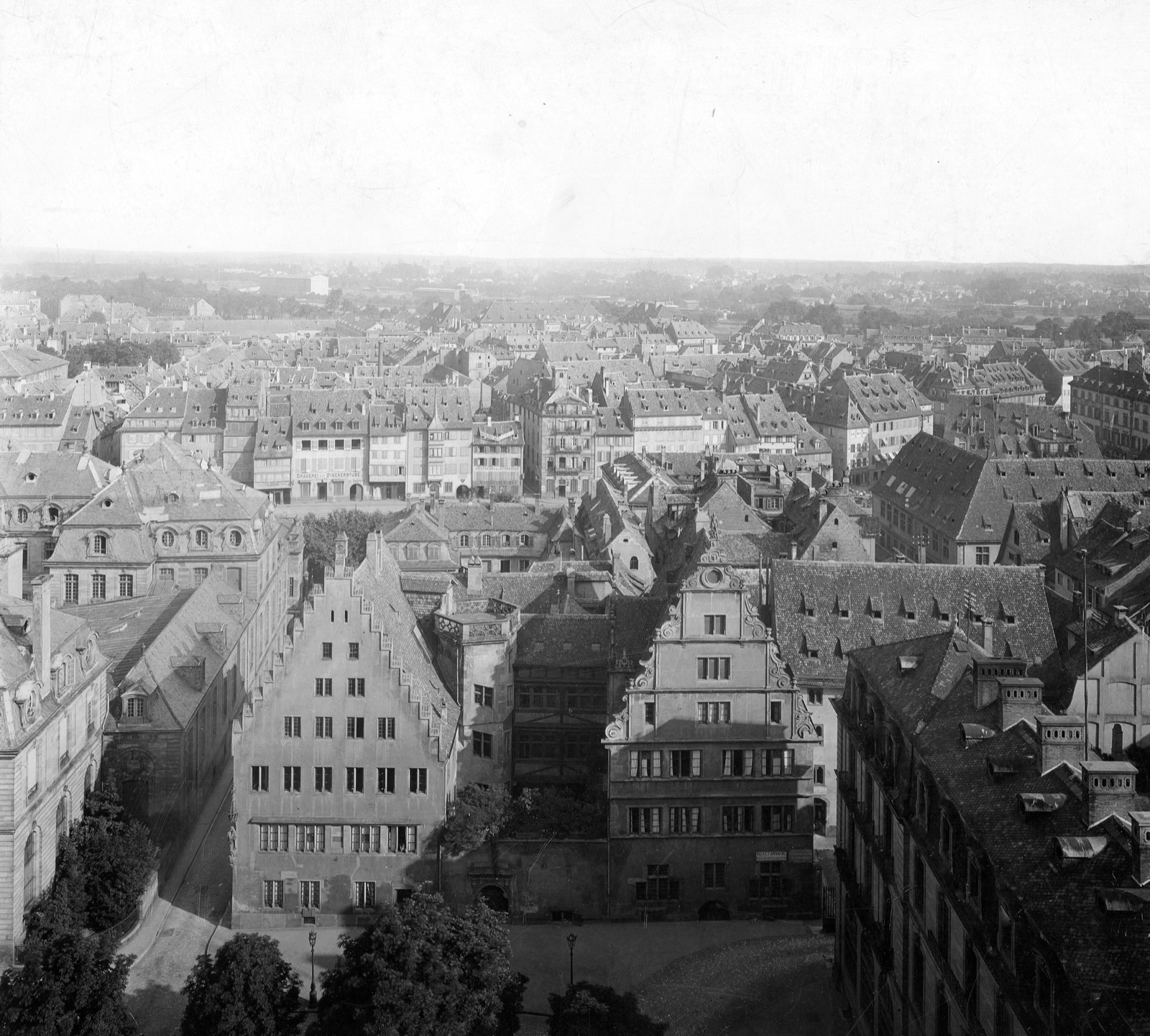
Archaeology was among the first to use it. In 1874 Stolze photographed Persepolis with a Meydenbauer camera, and in 1879 Meydenbauer drew the Friday Mosque of Shiraz from Stolze's photographs. The earliest graduated rods found in an archaeological photograph are older still, and stand on a monument: in John Burke's photographs of temple ruins in Kashmir, dated 1868, two black-and-white rods cross on the façade. Finds were shown differently. Schliemann's Atlas trojanischer Alterthümer (1874) photographs objects on shelves and writes the scale on the plate: terracottas from four metres down, at a quarter of their natural size.
In optics, Ernst Abbe named the telecentric lens in 1878: a system whose measuring factor does not depend on how far away the object is. He wrote it for measuring instruments, photographic apparatus among them. It is the one optical answer to the problem, and it returns later in every field that measures.
1869–1898: bodies, stars and the first doubts
Anthropology met the plane problem in 1869. John Lamprey proposed photographing people in front of a grid of two-inch squares, with the sitter standing some distance in front of it — so the scale lay behind the body. In the same year Thomas Huxley's scheme for the Colonial Office asked for measuring rods in the plane of the subject.
Astronomy measured from photographic plates from the 1880s. The first photographic parallaxes were taken at Oxford in 1886, and the congress that planned the Carte du Ciel in 1887 had a grid, the réseau, printed on every plate so that the plate's own shifts could be controlled. In 1893 Turner solved each plate's scale and orientation from stars of known position: the scale belonged to the plate, worked out afresh each time.
In archaeology the doubt came early. In the first volume of Excavations in Cranborne Chase (1887), Augustus Pitt-Rivers warned that skull drawings made at half size with a camera lucida could not always be trusted for measurement, because of perspective. By the fourth volume (1898) he wrote that "photographs cannot be relied upon for measurement" and measured the skulls with a craniometer of his own instead; his plates give the reduction, a quarter of natural size, and carry no scale.
In Paris, Alphonse Bertillon made the police photograph a measuring instrument. In La photographie judiciaire (1890) he fixed the judicial portrait at a reduction of one seventh. The reduction was set on a named plane: a 28 cm rule held vertically in the plane of the face, at the outer corner of the eye, had to appear 4 cm long on the plate. The reduction was to be written on every judicial photograph, so that the scale travelled with the picture.
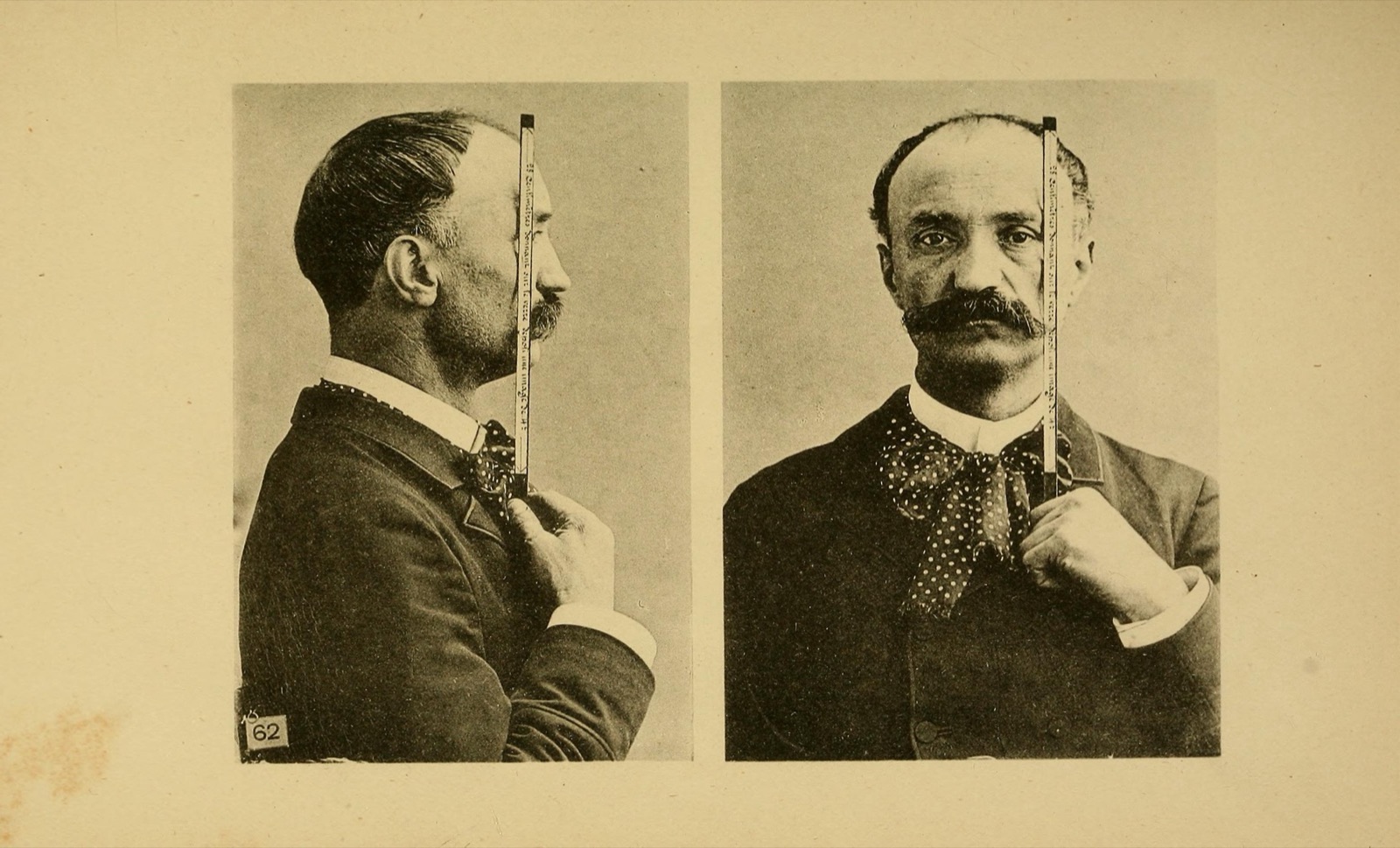
The English edition of 1896 goes a step further. Holding the rule was replaced by a rod fixed 19 cm in front of the back of the chair. Bertillon chose that distance as the average from the corner of the eye to the chair-back, measured on thirty people of different builds, so that the reduction could be made "in a uniform … manner". It is the earliest case found of handling an unknown depth by putting the scale's plane at a measured average depth — the same idea as correcting a measurement to the middle of an object's height.
1895–1913: X-rays, stereo instruments and the excavation plate
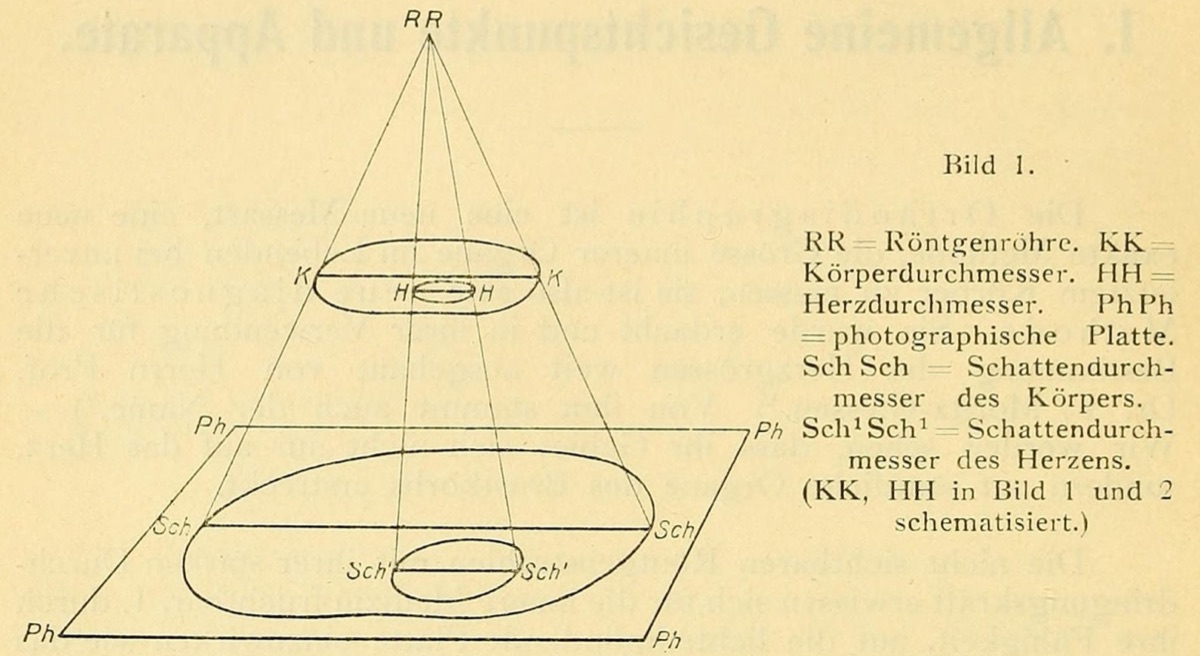
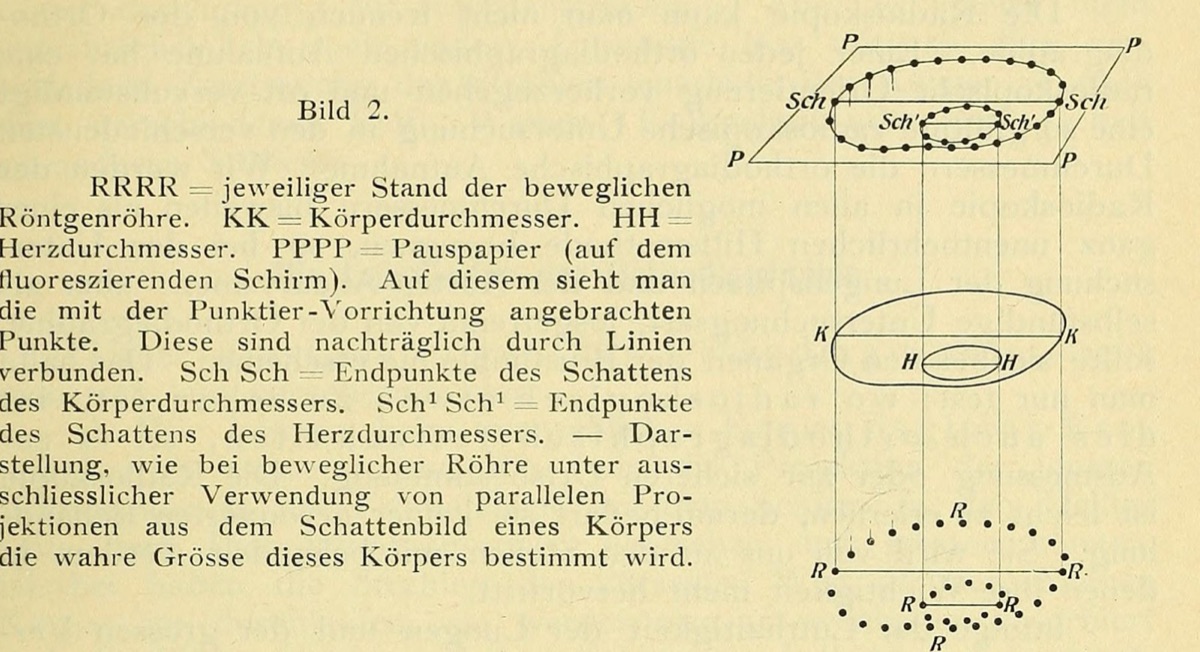
Radiology met PHOTARCH's problem more directly than any other field: an X-ray enlarges a body by an amount that depends on its depth. Stereo X-rays were taken within months of Röntgen's discovery. By 1897 Rosenfeld noted that the heart's outline was not much enlarged with the tube about 40 cm away; in 1898 Gocht recommended a metre, at which the heart could be measured almost without error. Moritz's orthodiagraph of 1900 traced only the ray perpendicular to the screen, so that the outline was drawn at true size. In 1908 Albert Köhler, using 1.5–2 m, tabulated the enlargement left at each distance. Increase the distance, and state what is left: radiology had both halves of the method by 1908.
Photogrammetry and astronomy shared an instrument: Pulfrich's stereocomparator, shown by Zeiss in 1901, was first tried on star plates, and von Orel's stereoautograph (1907–09) plotted contours directly from pairs of photographs.
From 1904 Bertillon applied his thinking to crime scenes, in what the press called métrophotographie: bodies and weapons were measured from the picture, a "perspectometer" helped draw the floor plan, and the prints were mounted with centimetre graduations and perspective frames. By 1907 there was an overhead camera on a tripod more than two metres tall; in 1913 a manufacturer offered the apparatus for identification, anthropology, archaeology and architecture. The scale came from the camera's fixed geometry, not from a ruler laid in the scene.
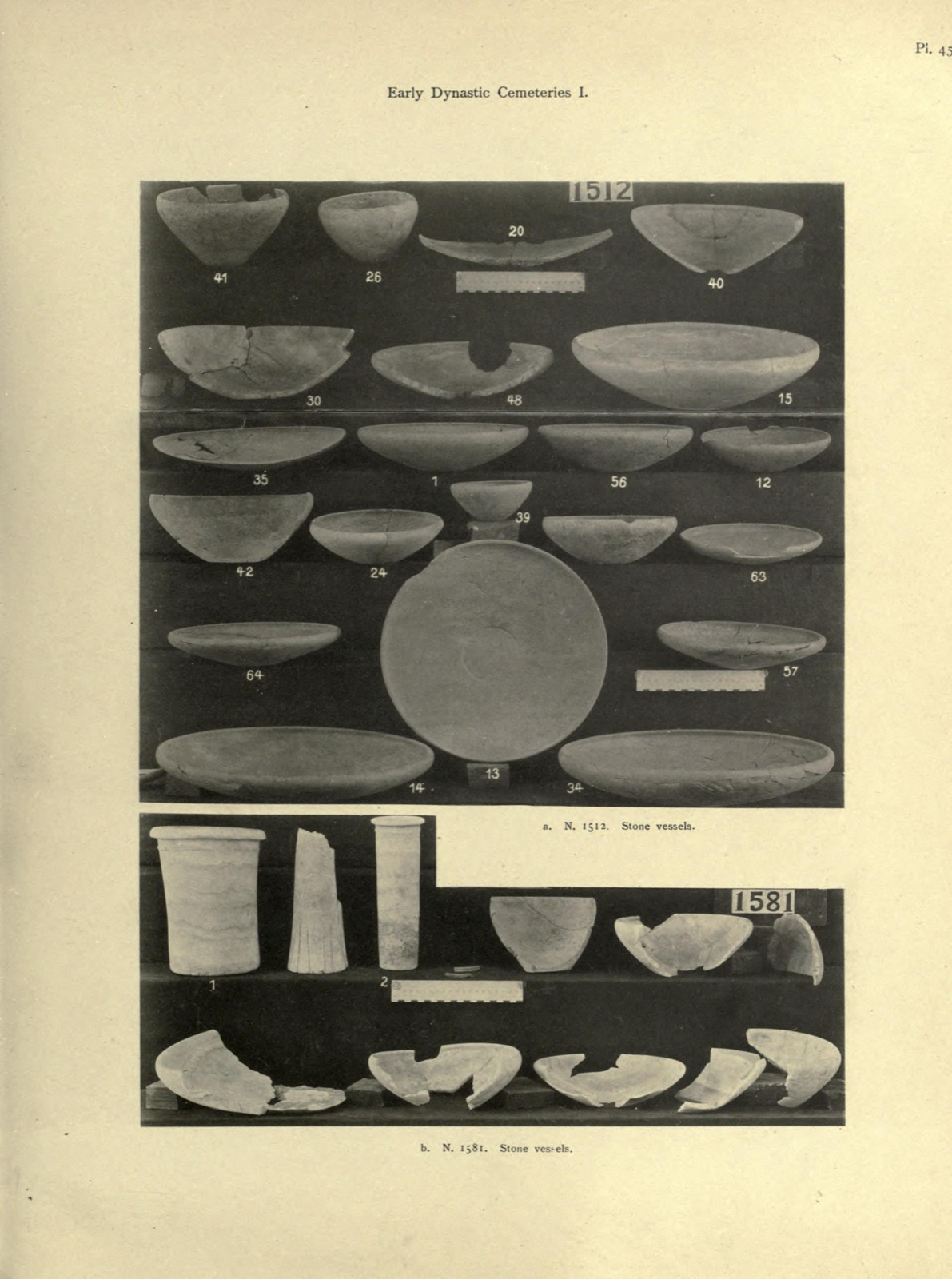
Flinders Petrie gave archaeology its rules for this in Methods & Aims in Archaeology (1904). A uniform scale, he wrote, comes from keeping the focal length unchanged and measuring the distance from camera to object, with the camera square to the object's plane; each plate keeps one scale, and "it should be stated in the heading of the plate". His own Royal Tombs (1900) captions its object photographs 4:3, 1:2 or 1:5. In the same years scales entered the frame. George Reisner's excavations at Naga-ed-Dêr (1901–03, published 1908) show a "meter staff" in the site photographs and, on one plate of vessels, a graduated strip in front of them as well as the stated 1:6 — the earliest object photograph with a scale in the frame found here. The Archaeological Survey of Nubia (1907–08) laid a black-and-white segmented bar in the grave beside the skeleton. Museum catalogues kept a third way: the Catalogue général of the Cairo Museum photographs objects against white without a scale, and gives the dimensions in the text. Archaeologists also went up: Giacomo Boni photographed the Roman Forum from an army balloon in 1899, and Stonehenge was photographed vertically from a war balloon in 1906.
1914–1931: war, aerial archaeology and fixed geometry
The First World War made aerial photography a mapping method, and showed its limit. An air photograph's exact scale and tilt could not be known from the picture itself, and rectification removed the tilt but left relief displacement; the first true photogrammetric mapping was done in Mesopotamia, where there was almost no relief. Archaeology followed the airmen. Theodor Wiegand's book of 1920 was the first with archaeological photographs taken from an aeroplane; O. G. S. Crawford, a wartime observer, used Royal Air Force photographs from 1922; and Wessex from the Air (1928) was flown with a captured German camera. In 1918 Pulfrich designed stereo instruments for X-rays and compared them with his plotter for topographic maps.
On the ground, excavation plates still mostly stated ratios. Petrie's plates for Tarkhan (1913), Gerar (1928) and Beth-Pelet (1930) are captioned 1:4, 5:8, 21:20 — ratios that suggest the scale was measured off the print afterwards — and the site views carry no scale. Brunton's Qau and Badari (1927) set an "INCHES" bar on the shelf at the foot of groups of vessels; the object plates from Samaria (published 1924) have none.
Anthropology wrote the problem down in 1928. Rudolf Martin's Lehrbuch der Anthropologie states that "das photographische Bild stellt keine Parallelprojektion eines Objektes dar" — a photograph is not a parallel projection of its object — and asks for a camera distance of at least two and a half times the subject's size, a scale beside the figure in the plane of focus, and, for true measurement, the Dioptrograph, an instrument for orthogonal projection. Three years later, in 1931, cephalometry fixed the geometry of source, head and film once and for all, by Broadbent in the United States and Hofrath in Germany.
1950s–1970s: the scale becomes archaeology's rule
Two handbooks of 1954 made a scale in every photograph the rule in archaeology, and both already said where it belongs. Mortimer Wheeler's Archaeology from the Earth asks for a scale, rod or human figure, parallel to the plate and in the same plane as the main feature, and notes how often a scale is put much nearer the camera than the small object it goes with; a scale in the middle of the picture, he adds, is usually bad. For a close object of some depth, a scale on the background gives a visible disparity, so it is to be "raised to the required height" on a strip of wood or plasticine. M. B. Cookson's Photography for Archaeologists explains that a photograph's scale alters with distance, puts poles in the foreground, middle and background of deep views, and sets the scale for pots upright, in the plane of their centres. Archaeology had written the same-plane rule down in 1954 — more than thirty years before forensic photography's ABFO scale and fifty before SWGTREAD.
It took a generation to become habit. In published site photographs a rod scale appears in 10 % in the 1950s and 50 % by the 1970s, according to Charlotte Carter's survey of the journals; counting tools and people used as scales, 55 % carried one at all.
Elsewhere, computing changed photogrammetry. Duane Brown's bundle adjustment of 1957–59 solved camera positions and points together by least squares, and his calibration models of 1966 and 1971 opened close-range measurement to ordinary cameras. In 1964 George Bass mapped the Yassıada shipwreck by stereophotogrammetry from a submarine, and the Venice Charter asked for monuments to be documented with drawings and photographs. In 1968 Maurice Carbonnell set out the case for heritage photogrammetry in ICOMOS's Monumentum: methods using a single photograph assume the subject is one plane, though a plate can be scaled for each plane of a building from distances measured on site. CIPA, the international committee for heritage photogrammetry, was founded at about the same time; the sources give 1968 to 1970. In forensics, fixed-base stereo cameras were used to record traffic accidents, and after the Warren Commission (1964) and a United States law on bank surveillance (1967) reverse projection was used to measure people in surveillance images. Medicine measured the skeleton in three dimensions with roentgen stereophotogrammetry from the early 1970s. Computer vision took up the old problem: Ullman (1979) and Longuet-Higgins (1981) recovered structure from several views, the latter citing the photogrammetry literature.
1985–1997: a scale for forensics, standards for files
The scale the forensic community recognises as its reference was designed for bite marks. William Hyzer and Thomas Krauss published the ABFO No. 2 in 1988 for the American Board of Forensic Odontology. It is L-shaped, with millimetre graduations on both legs, so that a grid can be projected over the plane the ruler lies in; three circles 80 mm apart show whether the camera is square to it, since a tilted camera draws them as ellipses. Its specification sets the graduations to ±0.1 mm, or ±1 % at the centimetre marks, and the legs square to two minutes of arc. It is accurate in its own plane, and says nothing about anything above or below it.
In biology, the landmark methods of the early 1990s compared shapes after scaling every specimen to the same size, so the question of depth was set aside rather than answered. For rock art, the IFRAO Standard Scale (proposed 1991, introduced 1994) combined a length scale with colour and grey patches, to be held parallel to the motif and at the same distance from the lens; beyond 4.5 m it could not be used with precision. The Museum of London's Archaeological Site Manual (1994) asked for a metric rod in every picture, parallel to the edge of the frame, and nothing else in it — no north arrow, no numbers — so the picture could be reused.
In 1992 the TIFF 6.0 specification defined the resolution fields that image files still carry, and said plainly that an image need not be shown or printed at the size they imply: they were import and display settings, not measurements of the object. In 1993 the US Army Corps of Engineers' photogrammetry manual stated the problem for aerial photographs in one line — "photographic scale can be defined only at a point" — and gave relief displacement, the outward shift of a raised point away from the centre of a vertical photograph, as d = r × h ÷ H. The same year DICOM 3.0, the standard for medical images, was published, and the Guide to the Expression of Uncertainty in Measurement (the GUM) appeared, reprinted with corrections in 1995.
1998–2007: computer vision, medicine and the forensic working groups
Archaeology was one of computer vision's first test grounds. Between about 1998 and 2003 the Leuven vision group turned uncalibrated video of Sagalassos into metric 3D models of the landscape and the ruins, with a known length to give the scale. In forensics, Criminisi and colleagues measured people's heights from single views, working with the UK Forensic Science Service. In 2002 the first peer-reviewed 3D model of a stone artefact was made with a scanner, and Erik Gantt compared caliper, photograph and scan measurements of Folsom stone tools in a master's thesis: the means for length and width differed by up to 7.9 %, 3.5 % on average.
Radiography counted the cost. In 2002 Conn, Clarke and Hallett showed that the enlargement of hip radiographs varies despite standard technique, so that templates for joint replacement mislead unless it is measured; a coin of known size improved the result. In 2006 a change to DICOM (CP-586) separated the pixel spacing at the detector, never to be altered, from a calibrated spacing at the patient, and made the file say how the calibration was done. Its reason was safety: vendors had been "correcting" images silently, and displays measured from different fields. The text states that a calibrated spacing holds near the central ray and at the depth of the calibration. In 2007 David Clunie found measurements of the same mammogram differing by 3–5 % between vendors, and showed how much the apparent size of a structure changes with its depth in the breast.
In the United States, forensic examiners formed scientific working groups to write shared guidance. The group for footwear and tyre evidence, SWGTREAD, first met in 2004. Its guide of March 2006 for photographing impressions at the crime scene puts a rigid scale in every photograph, beside the impression and at the plane of its bottom, with the film plane parallel to it and the focus on the bottom of the impression, not on the scale. In museums, the Canadian Museum of Civilization's digitisation standards of 2006 put the scale at the foot of the artefact and asked for it to be removable.
2008–2016: standards, structure from motion, and what scales are worth
In 2008 the GUM was reissued as JCGM 100:2008. Two of its rules matter here. A result is corrected for every recognised systematic effect, rather than having its uncertainty widened to cover it. When a quantity is known only to lie between two bounds, its best estimate is the middle, with a variance of the range squared divided by twelve.
The FADGI guidelines of the US federal agencies, first issued in 2009 and revised in 2010, included a category for objects and artefacts, specified only by pixel count. They already put reference targets at the same level as the surface being imaged, with the page of a thick book as the example. English Heritage's specifications for metric survey (2009) noted that rectification corrects tilt but not relief, and that the scale must lie in the subject's principal plane. The Dutch Metamorfoze guidelines of 2012 required that the size of the original can be calculated from a preservation master, with the resolution claimed in the file within 2 % of the real one.
In 2009 a report of the US National Research Council criticised the scientific basis of much forensic practice. A study at the US National Institute of Standards and Technology, published in 2013 and presented as consistent with that report, examined ABFO No. 2 scales from four makers. Every length scale met its ±1 % specification. The circles were often off size, and more than half the rulers were not square within the two minutes of arc allowed; their squareness also drifted over four years. The authors advised checking scales against certified rulers. In 2014 NIST and the Department of Justice set up OSAC, the Organization of Scientific Area Committees, to bring the separate working groups into a system of consensus standards.
Structure from motion reached archaeology as everyday software. Agisoft's PhotoScan appeared in 2010 and added coded targets and scale bars in 2012–13; by 2013 dense multi-view reconstruction could, in Verhoeven's words, "almost be considered a standard tool" in archaeology. Its models have no scale of their own: a known length, or calibrated scale bars — at least three, Cultural Heritage Imaging advised in 2015 — give them one. Photogrammetry was first used for a 3D model of a stone artefact in 2008, and became common from 2016.
The same error was being measured elsewhere. In geometric morphometrics, Andrea Cardini found in 2014 that sizes taken from side photographs of marmot skulls came out about 1.7 % too large, most likely because the scale lay behind the plane of the landmarks. In hip surgery, Sinclair and colleagues found that misplaced calibration balls gave a mean error of 6.8 %, up to 26 %, over 112 radiographs; a year later Boese and colleagues found that moving a marker 100–175 mm sideways changed its magnification by 1–2 %. Brecko and colleagues described low-cost focus stacking for type specimens in 2014, in which aligning the frames also corrects their parallax, so that the result is a composite rather than one view from one point. In archaeology, the US Veterans Curation Program raised the scale to the surface of the artefact nearest the lens, and aligned it flush-left — a convention taken, its author says, from forensic photography. The IIIF service for physical dimensions, published in 2014 and revised in 2015, let an image on the web carry one scale factor per view, and warned that such data is often missing or unreliable. In 2016 digitally created scale bars, pasted in after the photograph, were described as regular practice; the 2016 edition of FADGI asked for camera, lens and original to lie in parallel planes, and dropped the category for objects.
2017–2023: from guidance to standards, and a measurement
ISO 19264-1, first a technical specification in 2017 and a standard in 2021, analyses the image quality of a digitising system from a single picture of a test target, for flat originals. Historic England's guidance on photogrammetry (2017) noted that for small objects, callipers are a better reference than a scale bar.
In 2018 the American Board of Forensic Odontology's guidelines for bite marks put the scale in the same plane as the mark and next to it, with the sensor parallel, and noted that "image management software cannot correct for deficiencies" in this. On a curved surface several pictures are taken, each with the scale in the plane of its part. The Rijksmuseum's manual for photographing three-dimensional objects, from the same year, sets a neutral background at L* 80 and the whitest point at L* 97, but says nothing about scales.
SWGDE, the working group for digital evidence, put the rule into its general photography guidelines in 2019: the scale on the same plane as the item, or the item appears larger or smaller than it is, and the camera perpendicular to it. In 2021 SWGTREAD's guide became a consensus standard: ANSI/ASB Best Practice Recommendation 050, drafted through OSAC and published by the AAFS Standards Board, puts an L-shaped scale on the same plane as the bottom of the impression, the camera's focal plane parallel to it, checked with an angle finder.
In 2022 Dominik Göldner measured what the position of a scale bar does, for a distance on a skull replica: with the bar 10 cm nearer the lens the measurement came out 24 % too small, 5 cm nearer 13 % too small, in the plane 2 % too small, 5 cm further away 8 % too large and 10 cm further 19 % too large. He concluded that photographs should not be used for measurement unless specially calibrated. The same year OSAC set out a research need for three-dimensional imaging of footwear and tyre impressions. It described the proper practice — the scale at the depth of the impression's bottom — and conceded that the evidence often makes it impossible. In a United States case of 2022, Maryland v. Matthews, the court held that an unknown error rate went to the weight of reverse-projection photogrammetry rather than its admissibility. In 2023 Schiks and colleagues described a size reference projected onto the evidence by laser, without anything being placed; it does not deal with height. The third edition of FADGI, the same year, measures reproduction scale against the resolution written in the file, with tolerances from ±3 % to ±1 %, and still has no chapter for three-dimensional objects.
2024–2026: where things stand
SWGDE's guideline for macro photography (2024) repeats the rule, and adds that if no scale can be included, a picture of a scale is taken at the same focus distance; on a curved surface, focus is set halfway between the nearest and furthest detail. Metamorfoze 2.0 appeared in 2025. In a dataset of ground beetles published in 2026, scale bars were mounted at the specimens' own height on their pins, and measurements from the images agreed with calipers to about 0.15 mm. The Portable Antiquities Scheme, which records archaeological finds, asks that scales "lie at the same level as the object's centre" — Cookson's rule for pots, seventy years on — but prefers a digital scale bar pasted onto the picture afterwards, which shows no plane of its own; it warns that printers shrink printed scale bars by about 10 %, and calls foreshortening a problem that cannot be overcome. Image Scale Metadata (ISM), a draft of September 2026, writes a picture's scale into the file with how it was measured and how certain it is; the plane it holds in is described in words.
What the dates show across fields
The same problem arrived in clusters. Between the 1850s and the 1890s photography became a measuring instrument in five fields within about forty years — mapping, architecture, anthropology, astronomy and police work — and in each the scale was tied to a plane or a plate. X-rays brought the problem into medicine within two years of their discovery, and the Zeiss stereo instruments served photogrammetry, astronomy and radiology alike. The First World War pushed aerial mapping, X-ray localisation and aerial archaeology at once. Computing in the 1950s–70s brought analytical photogrammetry, then close-range and medical stereophotogrammetry. The digital image brought file standards in 1985–1995, and cheap cameras with computer-vision software brought structure from motion into archaeology around 2010. Between 2013 and 2015 the plane error was measured or ruled on in forensics, morphometrics, radiography and archaeology; none of the sources read cites another field's study.
Methods travelled — sometimes on record. Photogrammetry went to archaeology with Meydenbauer's camera at Persepolis (1874) and later through CIPA. Military balloons and aircraft went to archaeology in 1899, 1906 and after the First World War, often with the same men and cameras. Pulfrich likened his X-ray instrument to his map plotter (1918). Computer vision rediscovered photogrammetry, and says so; it then went to archaeology at Sagalassos and in the structure-from-motion software of 2010. Forensic evidence photography went to archaeology at the US Veterans Curation Program (2014). ISM names DICOM as its model, though it reached the same distinction between grids independently.
The triggers recur. A new way of making images — photography, X-rays, CT and MRI, digital cameras. War — 1870 ended Laussedat's research, the First World War made aerial mapping, missiles drove the bundle adjustment. Computing. Law and safety — the Prussian parliament debated photogrammetry's accuracy before 1885, surveillance law in 1967, the National Research Council's report of 2009, DICOM's "safety hazard" of 2006. Heritage doctrine and digitisation — the Venice Charter, FADGI, IIIF.
Much is parallel without lineage. The rule that a scale belongs in the plane being measured was written down independently by Huxley (1869), Bertillon (1890), Martin (1928), Wheeler and Cookson (1954), Carbonnell (1968), the ABFO (1988 and 2018), SWGTREAD (2006), English Heritage (2009) and SWGDE and the ASB (2019, 2021). No source found has one field citing another for it, except the Veterans Curation Program's debt to forensics. Lengthening the distance (Gocht, Köhler, Martin, Petrie's fixed distance) and the orthographic ideal (Abbe's telecentric lens, the orthodiagraph, the Dioptrograph) are the same ideas found again, not handed on. Bertillon's rod at a measured average depth and PHOTARCH's correction to half an object's height are a parallel, not a descent.
Archaeology's place
Archaeology took up measurement from pictures on two clocks. For sites and monuments it came early, within a few years of each new method and usually by borrowing: Meydenbauer's camera at Persepolis in 1874, military balloons in 1899 and 1906, wartime aerial photography in the 1920s, underwater stereophotogrammetry in 1964, structure from motion at Sagalassos before 2003 and as routine by 2013. For portable objects it came late. From Pitt-Rivers and Petrie to Wheeler, finds were photographed as single views with a stated reduction and then a scale. Archaeology wrote the same-plane rule down in 1954, earlier than forensics, but did not build fixed set-ups as radiology (1897–1908) and cephalometry (1931) did, did not tabulate the remaining error as Köhler did in 1908, and measured it only in two small studies, neither peer-reviewed. For more than a century the closest work on PHOTARCH's problem — a body with depth, enlarged in a single projection — was done in radiology and anthropology, not in archaeology.
What is settled
- A scale holds in one plane. Every field that measures from single pictures says so, from Bertillon's rule in the plane of the face and Wheeler's scale in the plane of the main feature to ANSI/ASB 050's scale at the bottom of the impression, through mapping, radiography, biology and the heritage standards.
- Put the scale in the plane that is measured, with the camera square to it. It is archaeology's rule since 1954 and forensics' since 1988, the one FADGI applies to the page of a book and the beetle dataset to its specimens.
- The scale travels with the picture. Drawn plates stated their reduction from 1770 on, the Nordic catalogues beside every figure; Bertillon wrote it on every print, Petrie in the heading of every plate; DICOM records the spacing and how it was calibrated; FADGI and Metamorfoze use the resolution in the file as the scale of a flat original.
- Correct a known error, and state what is left. The GUM's rule, with the middle of the range and its spread when only the bounds are known — and radiology's practice since Köhler.
What is still open
- No forensic or heritage standard measures the error when an object has height. Forensics avoids it by placing the scale; OSAC concedes that this is often impossible, and standards for 3D imaging are still a research need.
- Three-dimensional objects are outside the heritage imaging standards. FADGI has had no category for them since 2016, and ISO 19264-1 is written for flat originals.
- Few studies measure the size of the error. Morphometrics has Cardini's 1.7 %, radiography its marker studies; for archaeological objects there are two small studies, neither peer-reviewed — Gantt (2002) and Göldner (2022).
- Practice still differs. Archaeological guidance today puts the scale beside or at the foot of the object, raised to its upper surface, in the plane of its main feature, at the level of its centre, or pastes a digital bar in afterwards; Historic England prefers callipers for small objects.
- No general way to record where a scale holds. DICOM records how a calibration was made, ISM describes the plane in words; neither states it as a number for photographs of objects.
Where PHOTARCH stands
PHOTARCH takes the rules that are settled and works on what is open. It puts the scale in the plane of the outline where it can, with a caliper, as Wheeler, forensic practice and the beetle dataset do. Where the scale holds at the surface the object rests on — the board, a ruler — it corrects the measurement to half the object's height and states what is left as a margin: the GUM's rule, Köhler's practice of stating the remainder, and the same idea as Bertillon's rod and Cookson's scale at the centres of the pots. It writes the scale, how it was obtained and how certain it is into the file, as ISM. What no field has published is a measurement of the error for objects at scale; a test series with objects of known size and height is planned to measure it. The working is set out in Scale.
References · in the order of the history
- primaryScheiner, C. (1631). Pantographice.The pantograph: exact proportions of a flat original.
- primaryArchaeologia I (1770), pp. 1–2. Society of Antiquaries of London.A picture "reduced to the size of one fourth of the original", read in 1749.
- primaryCaylus, A. C. P. de (1752–67). Recueil d'antiquités.Dimensions in the text; some objects at natural size.
- historyMoser, S. (2014). Making expert knowledge through the image: connections between antiquarian and early modern scientific illustration. Isis 105(1), 58–99.Caylus's scales, section profiles and more uniform reductions.
- primaryWollaston, W. H. (1807). Description of the camera lucida. Nicholson's Journal 17, 1–5.Scale set by distance, true for a flat original only.
- primaryDescription de l'Égypte, Explication des planches, p. 58 (1809–29).The engraver altered measurements; the written dimensions are exact.
- historyManniche, L. (1986). The tomb of Nakht, the gardener, at Thebes (No. 161) as copied by Robert Hay. Journal of Egyptian Archaeology 72.Camera-lucida drawings and tracings straight from the wall.
- primaryStephens, J. L. (1841). Incidents of Travel in Central America, Chiapas, and Yucatan, vol. I, pp. 120, 137–138; vol. II, pp. 309, 312.Catherwood's camera lucida, his paper in sections, the scaffolds at Palenque.
- primaryStephens, J. L. (1843). Incidents of Travel in Yucatan, vol. I, preface and pp. 174–175.The daguerreotype tried at Uxmal and found wanting.
- institutionalBBAW. Lepsius-Archiv: Papierabdrücke.Squeezes as the most faithful facsimiles; tracings at full size.
- primaryCatherwood, F. (1844). Views of Ancient Monuments in Central America, Chiapas and Yucatan.Lithographs by six other hands; measurements in the text.
- primaryWorsaae, J. J. A. (1854). Afbildninger fra det Kongelige Museum for Nordiske Oldsager. Drawn and etched by M. Petersen.A reduction beside every figure.
- primaryMontelius, O. (1872–75). Antiquités suédoises. Drawn on wood by C. F. Lindberg.Reductions chosen per figure: ⅓ and ⅔ on one page.
- primaryMontelius, O. (1885). Om tidsbestämning inom bronsåldern, p. 244.A German figure drawn not at natural size, but at ⅔.
- historyHedman, S. (1999). Sörling, Faith-Ell och Händel — tre tecknare i Akademiens tjänst. Fornvännen 94(3), 179–186.Sörling's work for the Academy; drawing on wood for the engraver.
- primaryPetersen, M. (1909). Minder fra min Virksomhed paa Arkæologiens Omraade fra 1845 til 1908, pp. 15–16, 37.Photography will not do where form and measurement must be exact.
- historyPolidori, L. (2020). On Laussedat's contribution to the emergence of photogrammetry. ISPRS Archives XLIII-B2.Plans from perspectives from 1850, from photographs from 1861.
- historyAlbertz, J. (2001). Albrecht Meydenbauer — pioneer of photogrammetric documentation of the cultural heritage. Proc. 18th CIPA Symposium, Potsdam.The idea in 1858, the cameras and the word in 1867, the Messbildanstalt in 1885; a strictly vertical image plane.
- primaryCole, H. H. (1869). Illustrations of Ancient Buildings in Kashmir. Photographs by J. Burke.Graduated rods on a temple façade, 1868.
- primarySchliemann, H. (1874). Atlas trojanischer Alterthümer.The reduction written on the plate, no scale in the picture.
- primaryAbbe, E. (1878), in Gesammelte Abhandlungen, vol. 2.The term telecentric: a measuring factor independent of distance.
- primaryLamprey, J. H. (1869). On a method of measuring the human form, for the use of students in ethnology. Journal of the Ethnological Society of London.A grid behind the sitter.
- historyMIT Visualizing Cultures. John Thomson, China, essay 3.Measuring rods in the subject's plane, 1869.
- historyPerryman, M. (2012). The history of astrometry. arXiv:1209.3563.Photographic parallaxes from 1886; the Carte du Ciel and its réseau.
- primaryTurner, H. H. (1893). Monthly Notices of the Royal Astronomical Society 54, 11.Each plate's scale and orientation solved from known stars.
- primaryPitt-Rivers, A. (1887, 1898). Excavations in Cranborne Chase, vol. I, p. 166; vol. IV, pp. 21, 116.Perspective defeats measurement; photographs replaced by craniometer tracings.
- primaryBertillon, A. (1890). La photographie judiciaire. Paris: Gauthier-Villars, pp. 22–25, 75–81.The portrait at one seventh, set on the plane of the face; the reduction on every judicial photograph.
- primaryBertillon, A. (1896). Signaletic Instructions, ed. R. W. McClaughry. Chicago: Werner.A rod 19 cm in front of the chair-back, the average measured on thirty people.
- historyRadiology History & Heritage Charitable Trust (1998). Newsletter 10.Stereo X-rays in 1896.
- primaryKöhler, A. (1908). Teleröntgenographie des Herzens.Rosenfeld 1897 and Gocht 1898 on distance; the enlargement left at 1.5–2 m, tabulated.
- primaryFrancke, K. (1906). Die Orthodiagraphie.Moritz's orthodiagraph: only the perpendicular ray, the outline at true size.
- historyMeier, H.-K. (2003). 100 Jahre Stereophotogrammetrie. zfv 128.Pulfrich's stereocomparator, 1901, first tried on star plates.
- primaryPetrie, W. M. F. (1900). The Royal Tombs of the First Dynasty, part I.Object plates captioned with ratios.
- primaryPetrie, W. M. F. (1904). Methods & Aims in Archaeology. London: Macmillan, ch. VII.Scale from a fixed focal length and a measured distance; the camera square to the object.
- primaryReisner, G. A. (1908). The Early Dynastic Cemeteries of Naga-ed-Dêr, part I.A meter staff in site photographs; a graduated strip in front of vessels.
- primaryThe Archaeological Survey of Nubia, Report for 1907–1908, plates (1910).A segmented scale bar in the grave.
- historyCastro, T. (2011). Une cartographie du crime : les images d'Alphonse Bertillon. Criminocorpus.Metric photography of crime scenes from 1904; scaled and framed mounts.
- historyCollier, P. (2002). The impact on topographic mapping of developments in land and air survey: 1900–1939. Cartography and Geographic Information Science.Aerial photographs of uncertain scale and tilt; relief left after rectification.
- primaryCrawford, O. G. S. & Keiller, A. (1928). Wessex from the Air.Wiegand 1920; RAF photographs from 1922; a captured German camera.
- primaryBrunton, G. (1927). Qau and Badari I; Petrie, W. M. F. (1928). Gerar.An INCHES bar at the foot of vessels; ratios captioned on the plates.
- primaryMartin, R. (1928). Lehrbuch der Anthropologie, 2nd ed., vol. 1.A photograph is not a parallel projection; distance at least 2.5 times the subject.
- historyMeikle, M. C. (2004). Cephalometric radiography.Broadbent and Hofrath, 1931: fixed geometry.
- primaryWheeler, R. E. M. (1954). Archaeology from the Earth, ch. XV, pp. 175, 179.A scale in every photograph, in the plane of the main feature; raised for a deep object.
- primaryCookson, M. B. (1954). Photography for Archaeologists, pp. 42–43, 76.Scale alters with distance; for pots, a scale in the plane of their centres.
- empiricalCarter, C. (2015). The development of the scientific aesthetic in archaeological site photography. Bulletin of the History of Archaeology 25(2).Rod scales in 10 % of site photographs in the 1950s, 50 % in the 1970s.
- historyClarke, T. A. & Fryer, J. G. (1998). The development of camera calibration methods and models. Photogrammetric Record 16(91).Brown's bundle adjustment and calibration models.
- historyDrap, P. (2012). Underwater photogrammetry for archaeology. InTech.Yassıada, 1964.
- primaryCarbonnell, M. (1968). Introduction à l'application de la photogrammétrie aux édifices et aux ensembles monumentaux anciens. Monumentum 4. ICOMOS.Single-photograph methods assume one plane; a plate scaled per plane from distances measured on site.
- guidanceSWGDE (2022). Technical overview for reverse projection photogrammetry.The Warren Commission; bank surveillance from 1967.
- empiricalLonguet-Higgins, H. C. (1981). A computer algorithm for reconstructing a scene from two projections. Nature 293.Structure from two views, citing photogrammetry.
- standardHyzer, W. G. & Krauss, T. C. (1988). The bite mark standard reference scale — ABFO No. 2. J Forensic Sci 33(2), 498–506. Specification as quoted by Ferrucci et al.An L-shaped scale for its own plane; three circles to check the camera is square.
- historyAdams, D. C., Rohlf, F. J. & Slice, D. E. (2004). Geometric morphometrics: ten years of progress following the "revolution".Shapes compared after scaling to one size.
- standardBednarik, R. G. (2001). The IFRAO Standard Scale.Proposed 1991, introduced 1994; parallel to the motif, not precise beyond 4.5 m.
- guidanceMuseum of London Archaeology Service (1994). Archaeological Site Manual, 3rd ed., §6.A metric rod in every picture, parallel to the frame; nothing else in it.
- specificationAldus Corporation (1992). TIFF Revision 6.0.Resolution fields as import and display settings.
- methodUS Army Corps of Engineers (1993). EM 1110-1-1000, Photogrammetric Mapping, ch. 10.Scale defined only at a point; relief displacement d = r × h ÷ H.
- standardNEMA. DICOM: history.DICOM 3.0 published in 1993.
- empiricalVan Gool, L. et al. (c. 2000). Image-based 3D modeling: modeling from reality.Sagalassos from uncalibrated video; a known length for scale.
- empiricalGantt, E. M. (2002). The Claude C. and A. Lynn Coffin Lindenmeier Collection. MA thesis, Colorado State University, pp. 77–79.Caliper, photograph and scan means differ by up to 7.9 %.
- empiricalConn, K. S., Clarke, M. T. & Hallett, J. P. (2002). A simple guide to determine the magnification of radiographs and to improve the accuracy of preoperative templating. J Bone Joint Surg Br 84(2), 269–272.Magnification varies despite standard technique; a coin of known size helps.
- historyHammer, L. (2010). SWGTREAD, slides. NIJ Impression and Pattern Evidence Symposium.First meeting in 2004.
- standardDICOM Standards Committee (2006). CP-586: Pixel spacing and calibration in projection radiography; current text in PS3.3 §10.7.Detector spacing kept apart from calibrated spacing; how the calibration was made recorded in the file.
- guidanceSWGTREAD (2006). Guide for the forensic documentation and photography of footwear and tire impressions at the crime scene. Superseded by ANSI/ASB 050.The scale at the plane of the impression's bottom; focus on the bottom, not the scale.
- guidanceBrosseau, K., Choquette, M. & Renaud, L. (2006). Digitization Standards for the Canadian Museum of Civilization Corporation, v1.1.The scale at the foot of the artefact, removable.
- empiricalClunie, D. A. (2007). On the matter of size and distance measurements in digital mammography. IHE white paper.3–5 % between vendors; apparent size changes with depth.
- standardJCGM 100:2008. Guide to the expression of uncertainty in measurement (GUM), §3.2.4, §4.3.7, §6.3.1.Correct known errors; the middle of a range, with its spread, when only the bounds are known.
- guidelineFADGI (2010). Technical Guidelines for Digitizing Cultural Heritage Materials, revised August 2010.A category for objects, by pixel count; targets at the level of the imaged surface.
- guidanceBryan, P., Blake, B. & Bedford, J. (2009). Metric Survey Specifications for Cultural Heritage. English Heritage.Rectification corrects tilt, not relief; the scale in the principal plane.
- guidelinevan Dormolen, H. (2012). Metamorfoze Preservation Imaging Guidelines, version 1.0. KB National Library of the Netherlands.The size of the original must be calculable; the claimed resolution within 2 %.
- empiricalFerrucci, M. et al. (2013). Dimensional review of scales for forensic photography. NIST / NIJ; J Forensic Sci 61(2), 509–519 (2016).Length scales within specification; circles and squareness often not.
- empiricalVerhoeven, G. et al. (2013). Undistorting the past: new techniques for orthorectification of archaeological aerial frame imagery.Structure from motion a standard tool in archaeology by 2013; early balloon photography.
- institutionalNIST (2014). Organization of Scientific Area Committees for Forensic Science.Set up in 2014 to bring the working groups into consensus standards.
- empiricalCardini, A. (2014). Missing the third dimension in geometric morphometrics. Hystrix 25(2), 73–81.Size from side photographs about 1.7 % too large.
- empiricalSinclair, V. F. et al. (2014). Assessment of accuracy of marker ball placement in pre-operative templating for total hip arthroplasty. J Arthroplasty 29(8), 1658–1660. doi:10.1016/j.arth.2014.03.013Mean 6.8 %, up to 26 %, over 112 radiographs.
- empiricalBrecko, J. et al. (2014). Focus stacking: comparing commercial top-end set-ups with a semi-automatic low budget approach. ZooKeys 464, 1–23.Stacked images are composites.
- practiceRivera, P. S. (2014). Applying the methods of evidence photography to archaeological collections. Technical Briefs in Historical Archaeology 8, 22–31.The scale raised to the surface of the artefact.
- specificationIIIF (2014, revised 2015). Physical Dimensions service.One scale factor per view, with a warning that such data is often unreliable.
- guidanceCultural Heritage Imaging (2015). Guidelines for Calibrated Scale Bar Placement and Processing, v2.0.At least three calibrated bars, ideally four.
- empiricalBoese, C. K. et al. (2015). Calibration markers for digital templating in total hip arthroplasty. PLOS ONE 10(7).Moving a marker 100–175 mm sideways changes its magnification by 1–2 %.
- practiceMorgan, C. (2016). A brief contextualisation of analog photography in archaeology. Internet Archaeology 42.Digital scale bars pasted in as regular practice.
- guidelineFADGI (2016). Technical Guidelines for Digitizing Cultural Heritage Materials.Parallel planes; no category for objects.
- standardISO 19264-1:2021. Imaging systems quality analysis — Part 1: Reflective originals. Technical specification 2017.
- guidanceHistoric England (2017). Photogrammetric Applications for Cultural Heritage: Guidance for Good Practice.Callipers a better reference than a bar for small objects.
- guidanceAmerican Board of Forensic Odontology (2018). Standards and Guidelines for Evaluating Bitemarks.The scale in the plane of the mark; several pictures on a curved surface.
- institutionalRijksmuseum (2017). Manual for the Photography of 3D Objects.Background at L* 80; nothing on scales.
- guidanceSWGDE (2019). General Photography Guidelines for the Documentation of Evidence Items in the Laboratory, v1.0.The scale on the item's plane, the camera perpendicular.
- standardANSI/ASB (2021). Best Practice Recommendation 050: Photographic documentation of footwear and tire impression evidence, 1st ed. AAFS Standards Board.An L-shaped scale on the plane of the impression's bottom; the focal plane parallel.
- empiricalGöldner, D. (2022). ArchaeoScale protocol: inserting digital scale bars into scientific images. Zenodo.A bar 10 cm off the plane: −24 % and +19 %.
- empiricalWyatt-Spratt, S. (2022). After the revolution: a review of 3D modelling as a tool for stone artefact analysis. Journal of Computer Applications in Archaeology 5.3D models of stone artefacts: scanner 2002, photogrammetry 2008, common from 2016.
- research needOSAC Footwear & Tire Subcommittee (2022). Development, testing and validation of 3D imaging technologies.Correct placement is often impossible; 3D standards still needed.
- legalState of Maryland v. Kirk Matthews (2022). Court of Appeals of Maryland.Unknown error rate goes to weight, not admissibility.
- empiricalSchiks, L. A. H. et al. (2023). Contactless size reference in forensic photography — design and verification of the novel FreeRef-1 system. Sensors 23(8), 3790.A projected reference; height not addressed.
- guidelineFADGI (2023). Technical Guidelines for Digitizing Cultural Heritage Materials, 3rd ed.Reproduction scale against the file's resolution, ±3 % to ±1 %; no chapter for objects.
- guidanceSWGDE (2024). Guidelines for the Use of Macro Photography in Forensic Science, 24-P-001.A separate picture of a scale at the same focus distance when none can be included.
- guidelinevan Dormolen, H. (2025). Metamorfoze Preservation Imaging Guidelines, version 2.0.
- empiricalRayeed, S. M. et al. (2026). A continental-scale dataset of ground beetles with validated morphological trait measurements. arXiv:2601.10687.Scale bars at the specimens' height; image and caliper agree to about 0.15 mm.
- practicePortable Antiquities Scheme. How to take a photograph. British Museum (accessed 4 October 2026).Scales at the level of the object's centre.
- formatImage Scale Metadata (ISM), version 0.1, draft for comment, September 2026.The scale in the file, with its method and uncertainty; the plane in words.