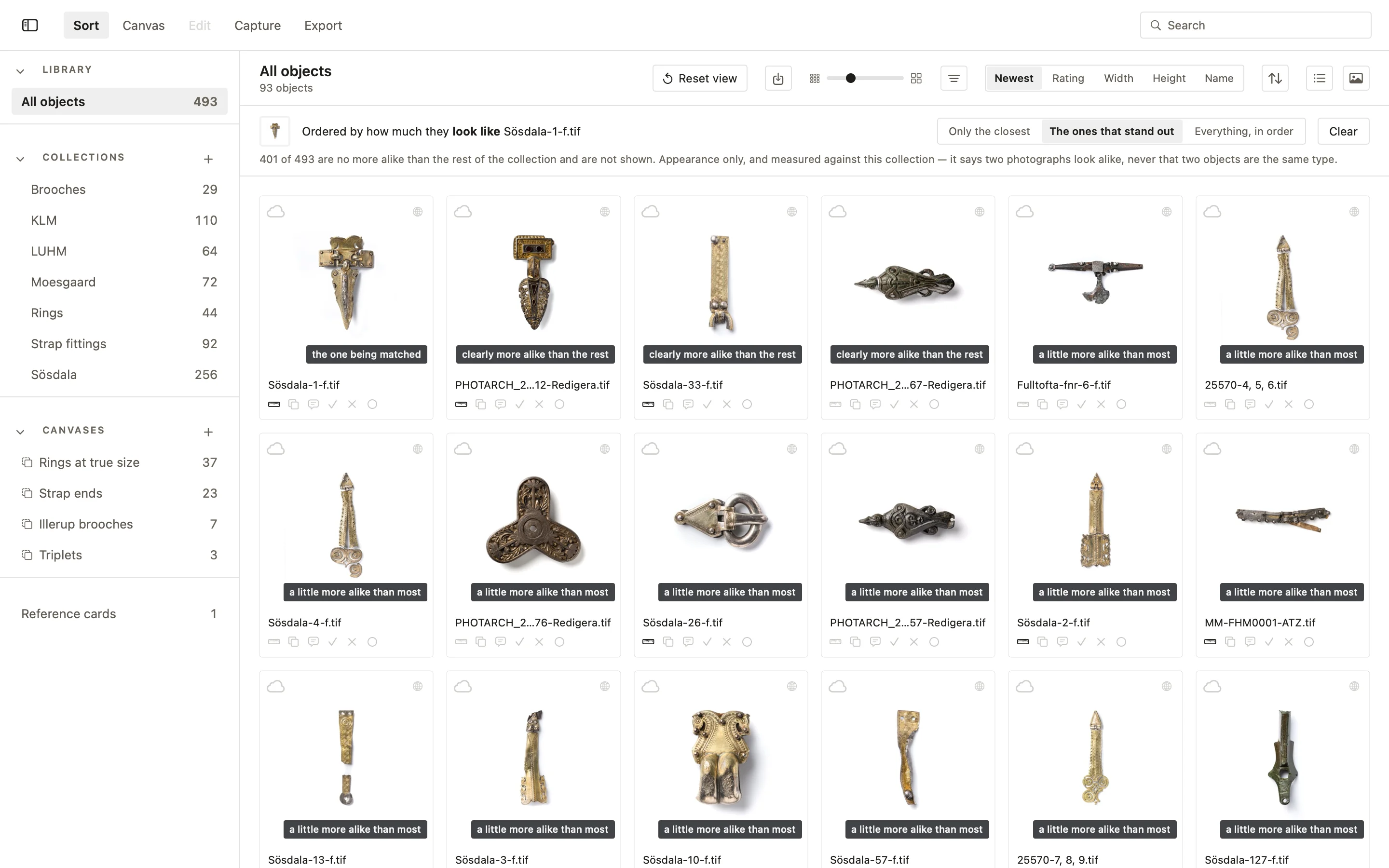
Sort by appearance
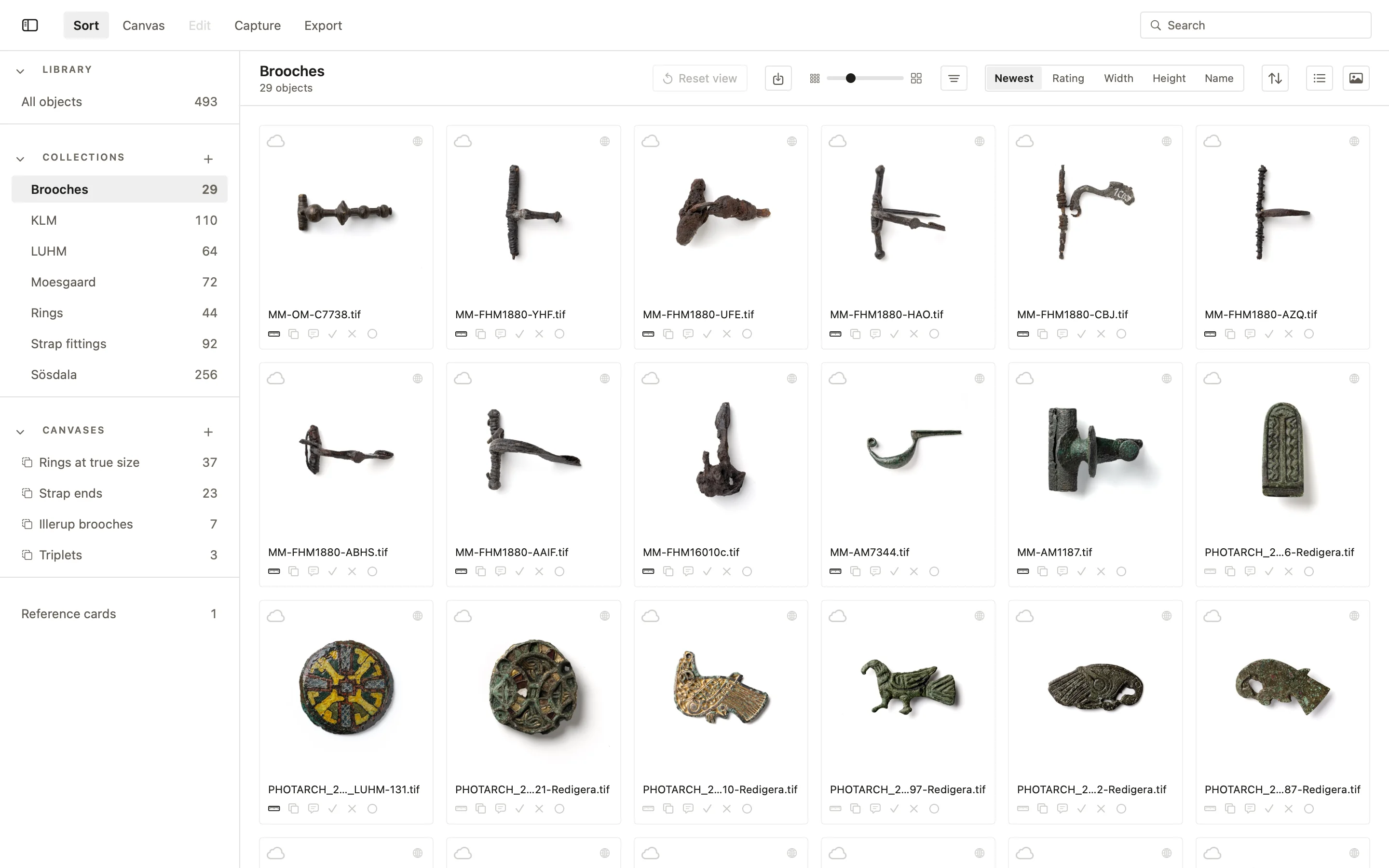
Orders the objects by how much they look like one you choose, so similar objects end up side by side without a word being typed.

PHOTARCH — a visually driven database.
A photograph of an object is only evidence if someone else can trust what it shows. The PHOTARCH app takes a finished image and makes it verifiable: the scale is measured in millimetres, the colour is checked against a ColorChecker, and the record travels with the file.
Use it as your archive or as a funnel into your existing system.
01 — The difference
▸ 21PHOTARCH
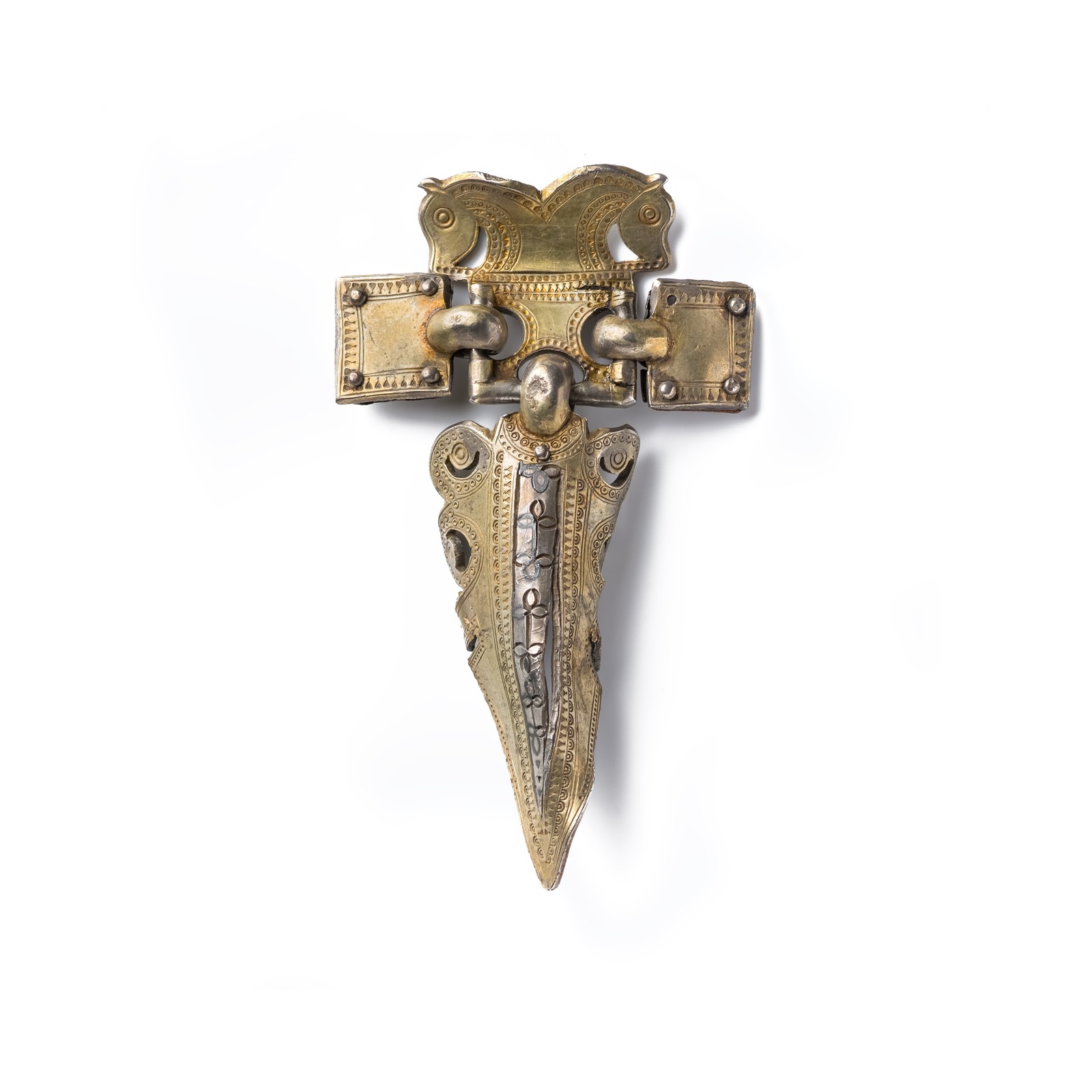
5063
▸ 21ASAFETY FILM
▸
▸ 22PHOTARCH
IMG_4402.JPG5063
▸ 22ASAFETY FILM
102.0 × 59.4 mm▸
Its size is anyone’s guess.
Lit by whatever was in the room.
The file says nothing about what it shows.
Millimetres per pixel, colour against a ColorChecker, and the record inside the file.
Digitisation comes with a long list of standards, rules and recommendations, and as many abbreviations to tell apart. With PHOTARCH you do not have to: it does all that for you.
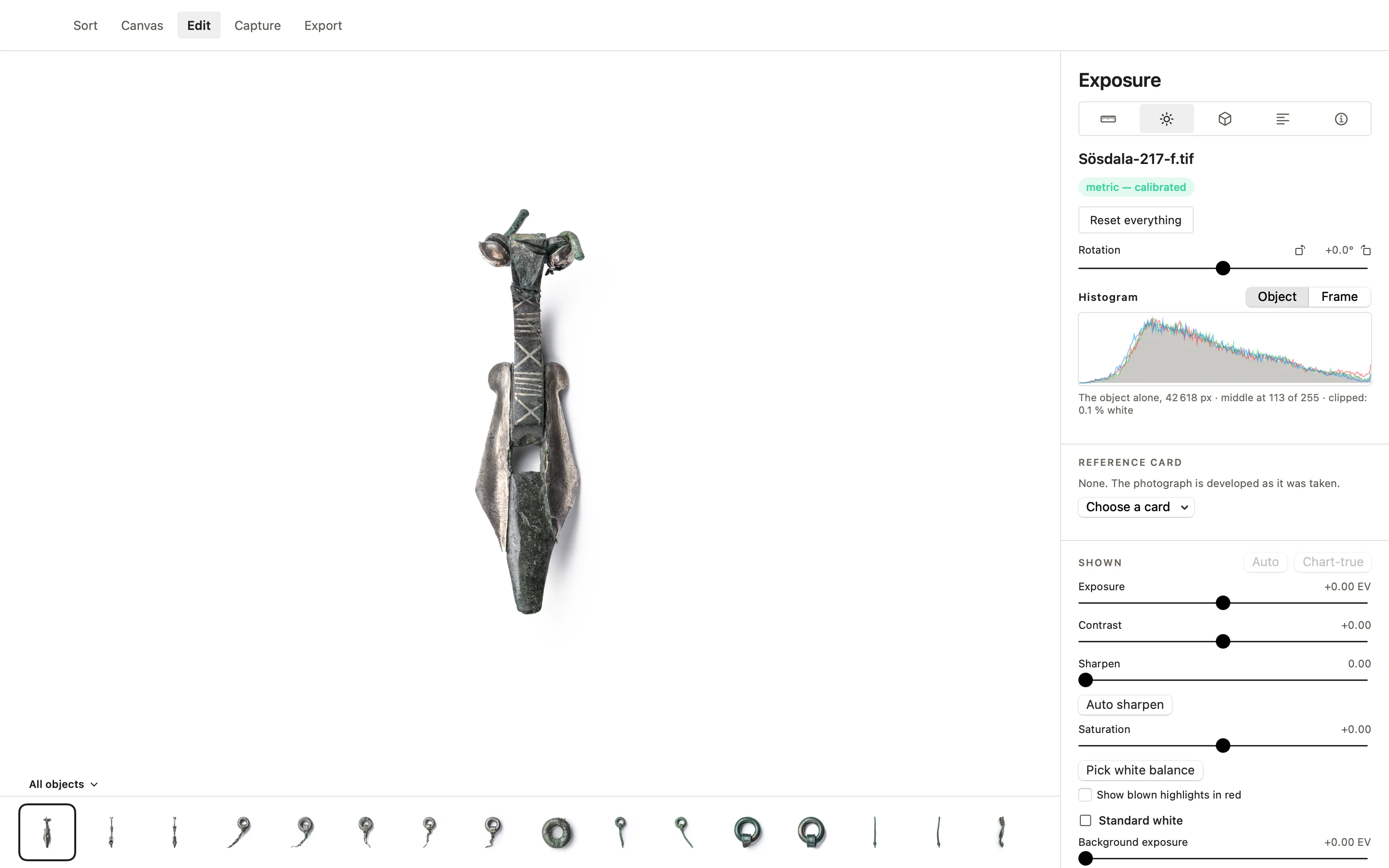
Take the picture as well as you can. The app brings it to its best version, without ever altering the original, and says in plain words what it is fit for: a record shot, a study or a reproduction. When you are ready you export it with everything it needs for where it is going next.
FADGI, ISO 19264-1 and Metamorfoze were written for paintings, documents and other flat originals. The app keeps them out of the way, and turns them on, clearly labelled, for whenever they are needed.
02 — The method
1
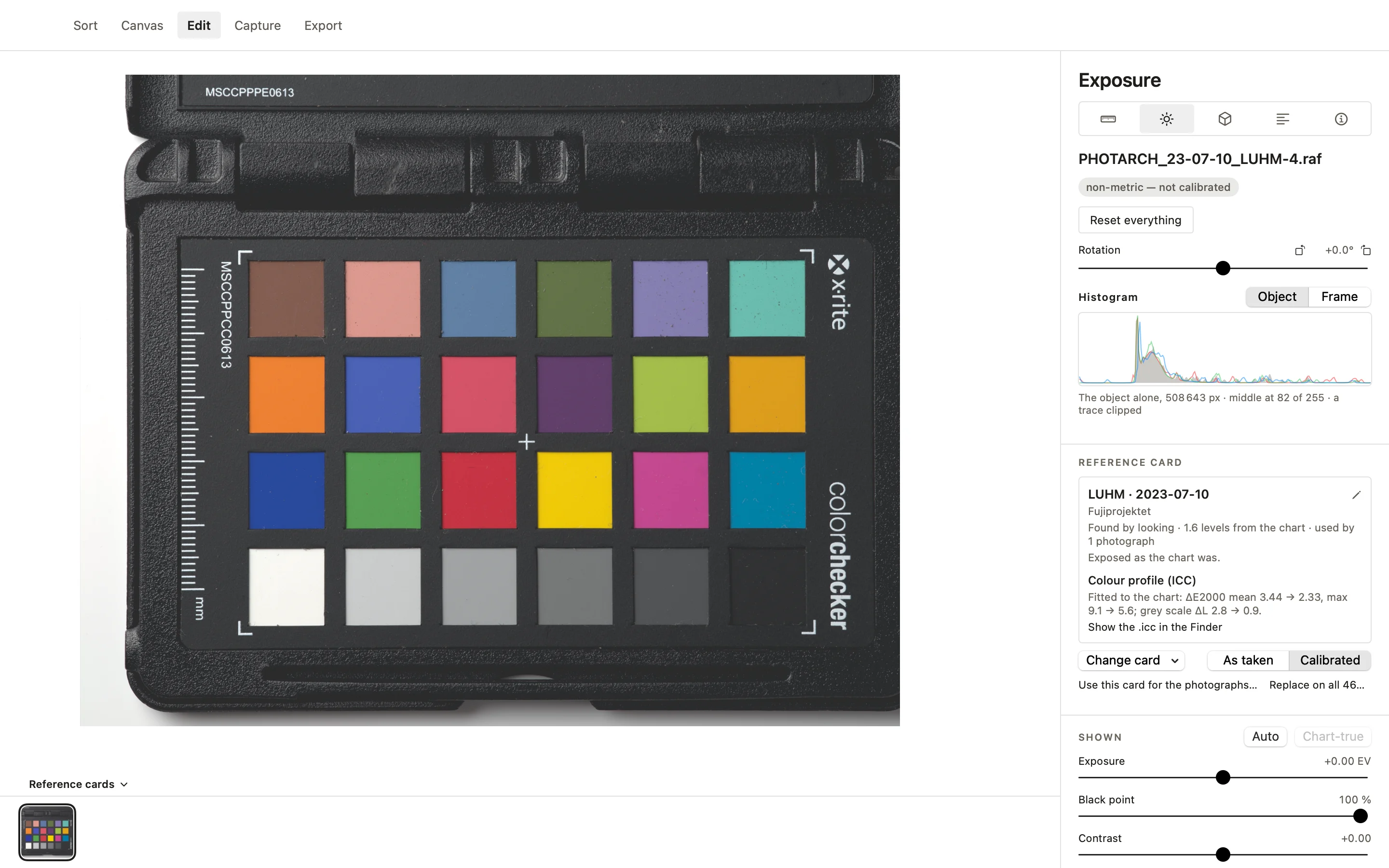
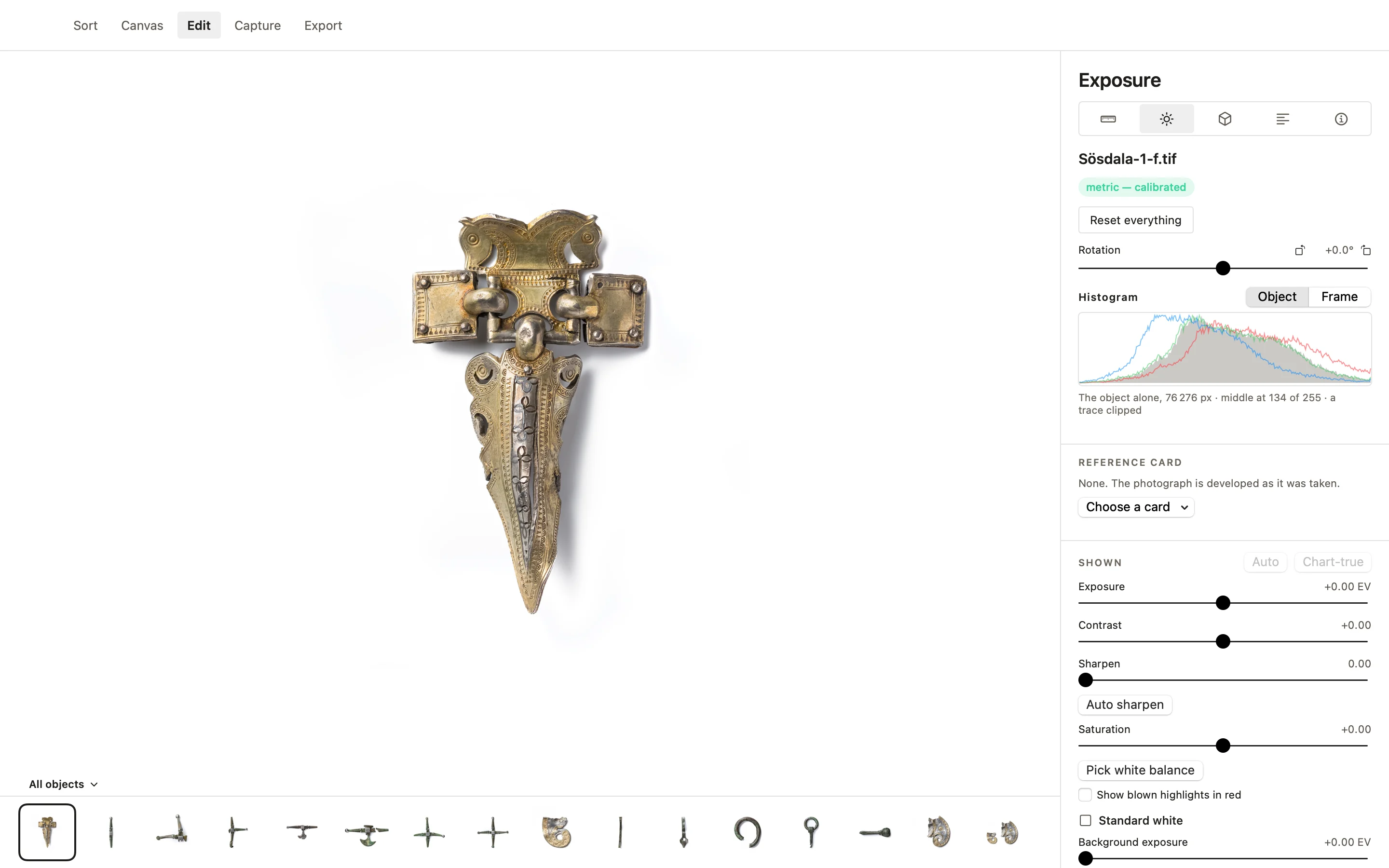
The app checks exposure, sharpness and colour — while the picture is taken and after. At capture, three lights say whether the middle of the frame is sharp, whether highlights are clipping and whether the board reads flat and square. Afterwards it measures the scale, the resolution at the object, how much of the object is in focus and how much of it is clipped, the colour against a ColorChecker, the bits the camera recorded and the format, and says what each picture is fit for: a record shot, a study or a reproduction, and what keeps it from the next. For paintings, documents and other flat originals, FADGI, ISO 19264-1 and Metamorfoze can be turned on.
2
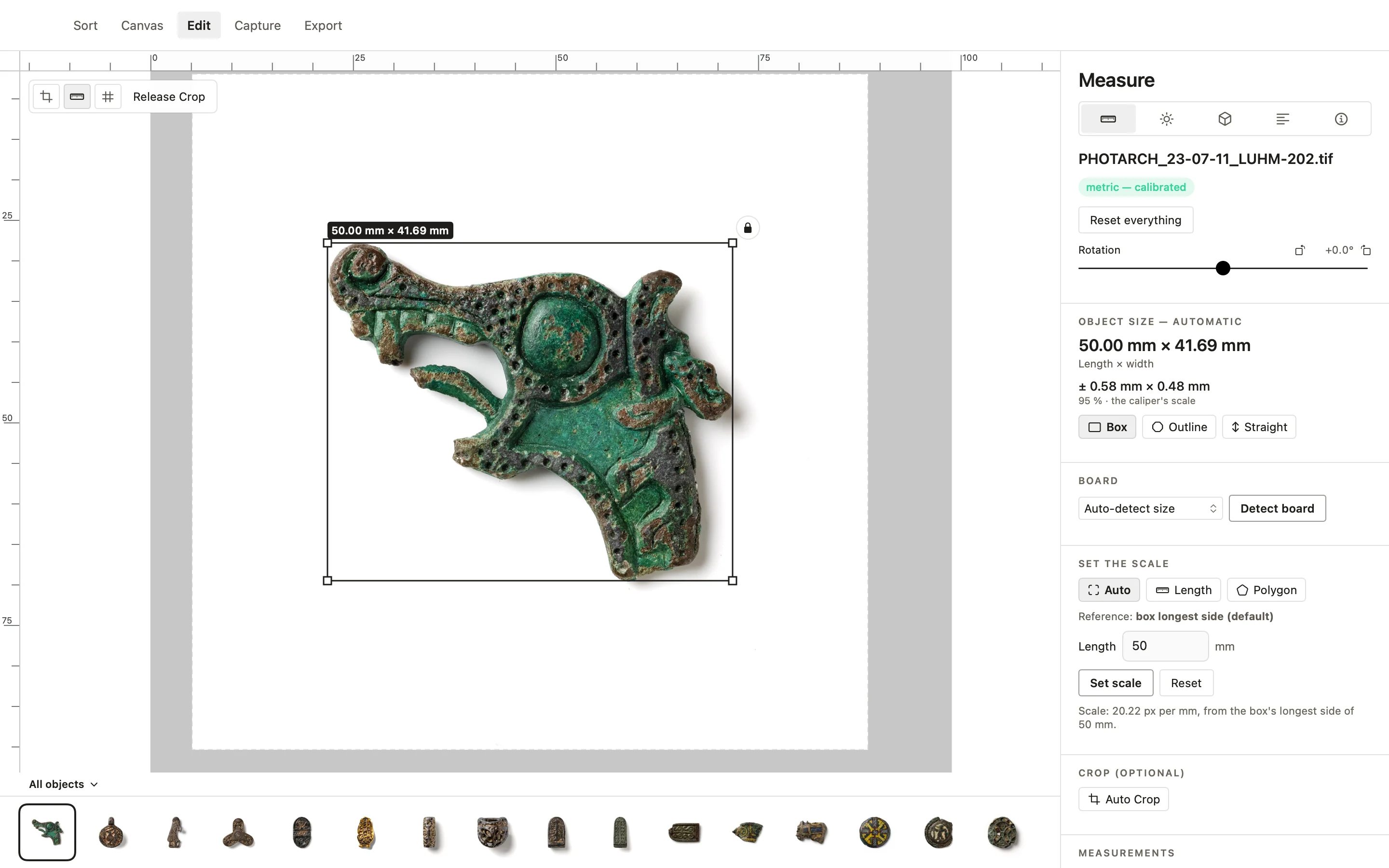
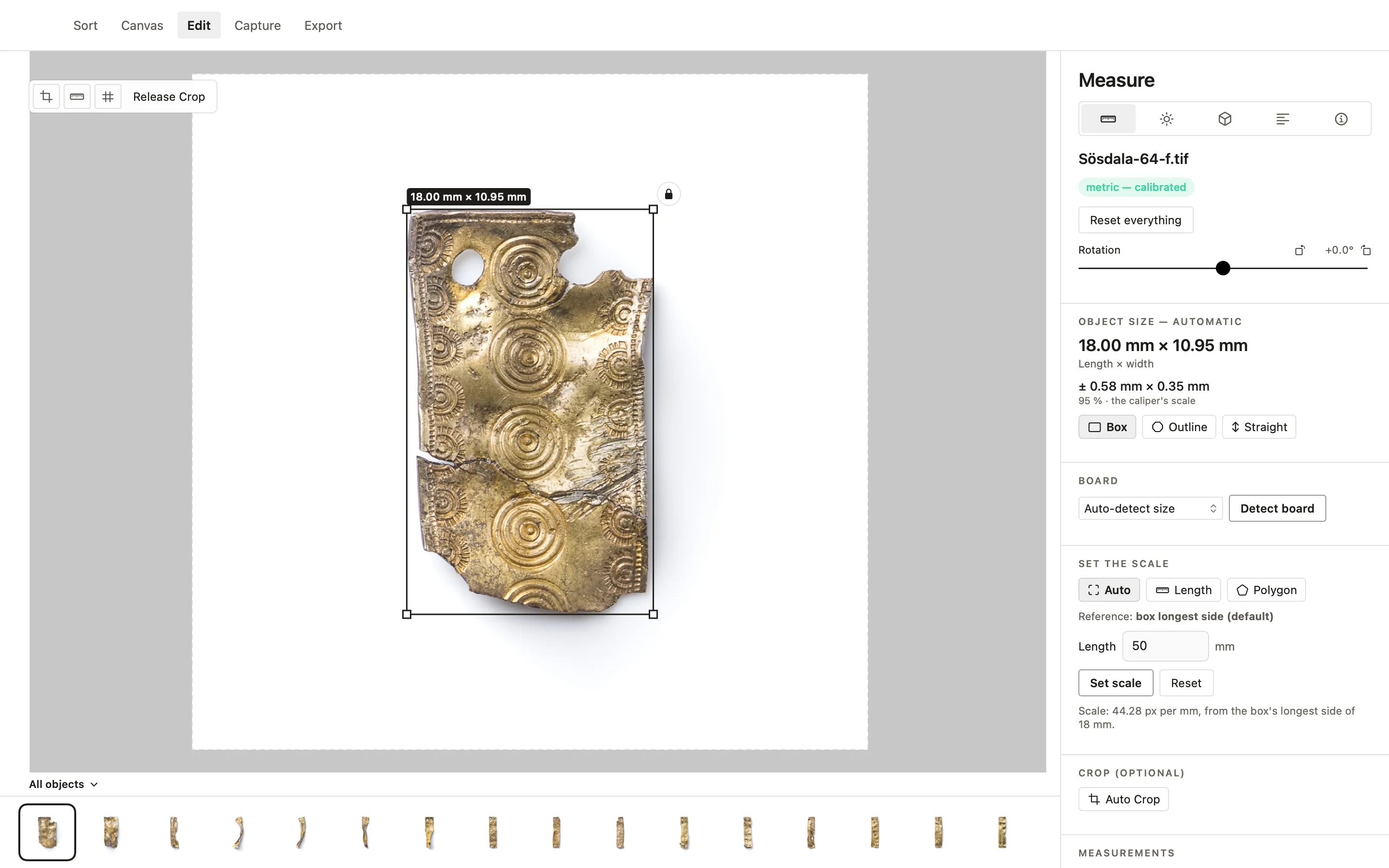
Scale comes from the object’s longest side, measured with a digital caliper — or, calibrated, from the PHOTARCH board, whose markers lie in the object’s own plane — not from a guess. A ruler in the frame is only a fallback. Every object carries millimetres per pixel, a bounding box and its real dimensions, so two objects can be laid side by side at true size.
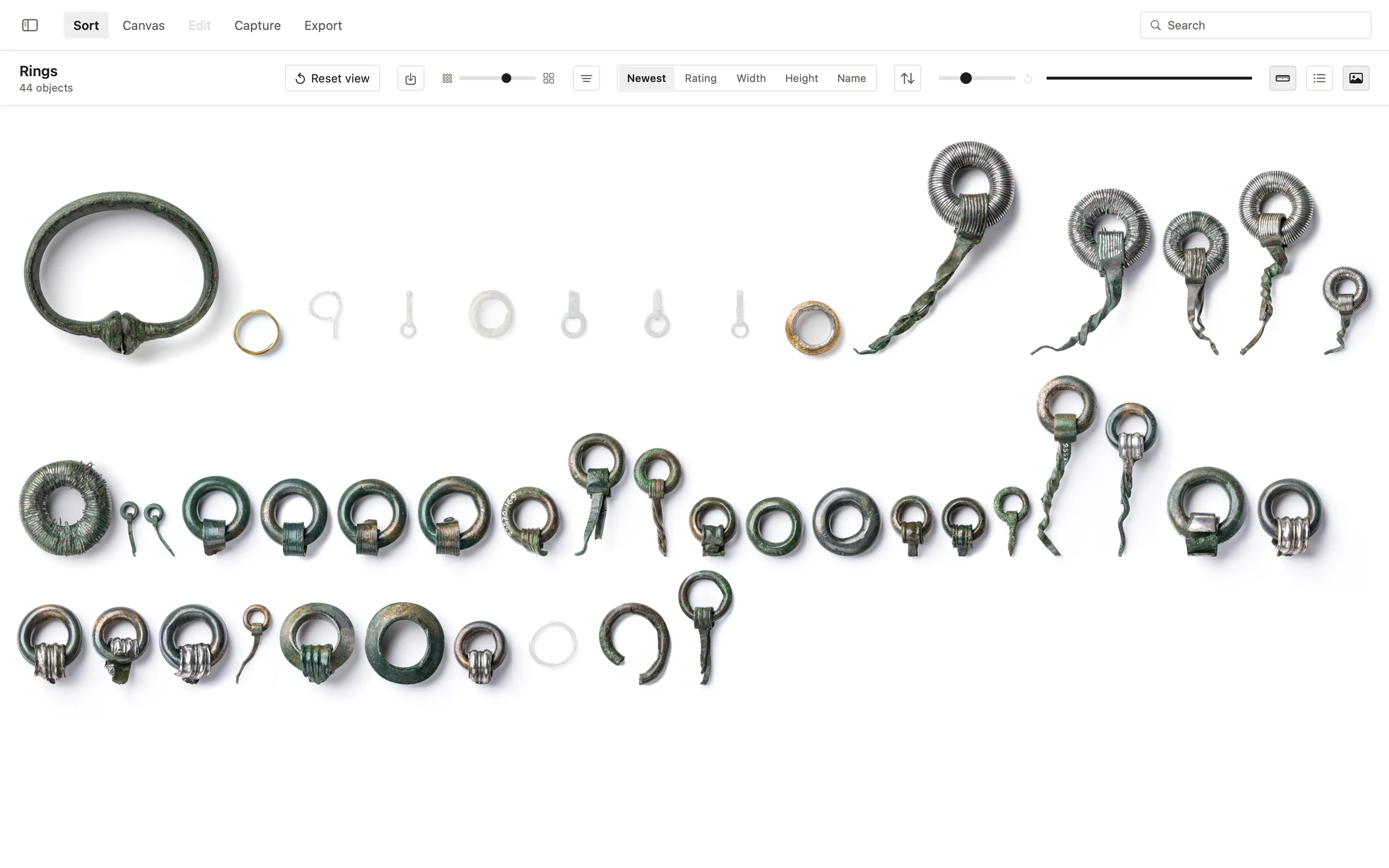 one scale for all of them
3
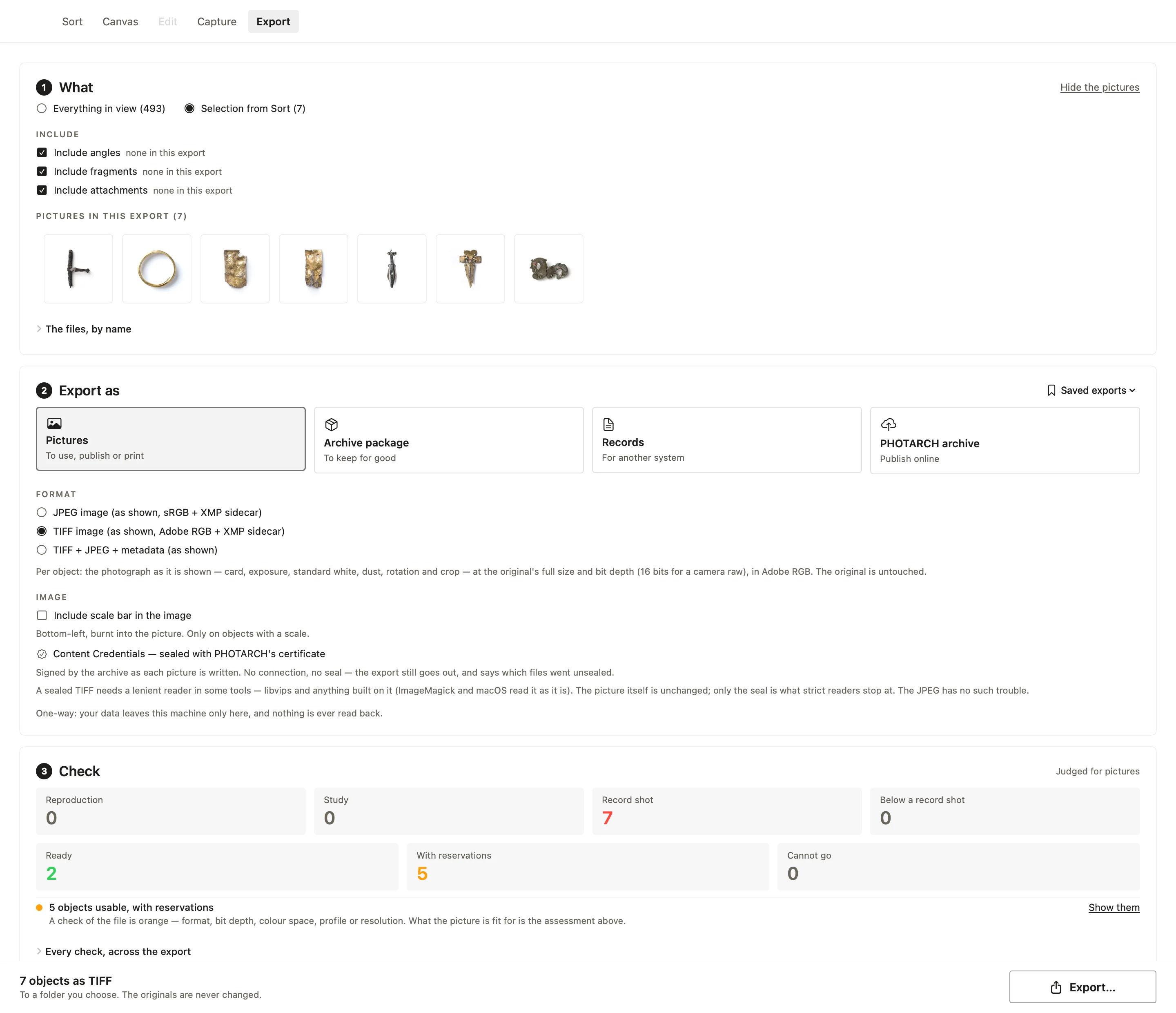
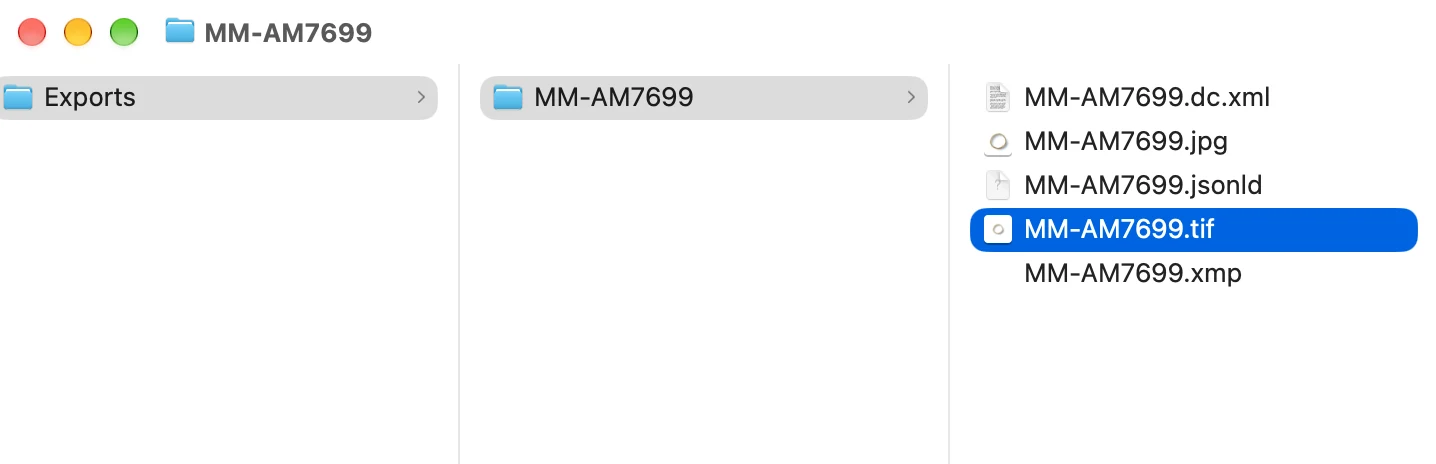
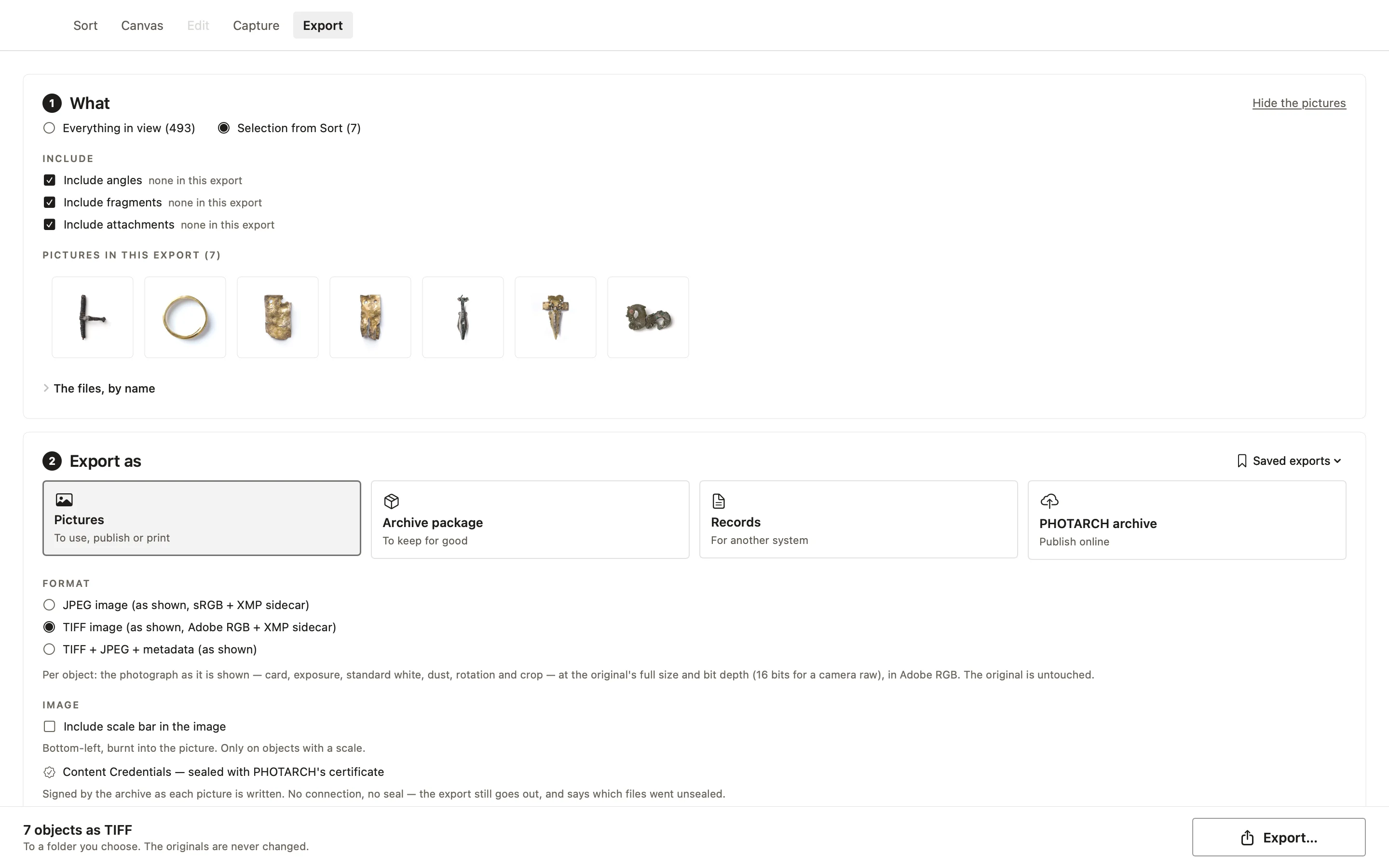
The master is never altered. An export gathers what the museum’s own collection system takes in — the TIFF, a JPEG, the attachments and the record as CSV or a standard format — with the metadata written into the files, so the evidence survives the software that made it.
03 — Where it goes
Museums and archives already keep their collections in a system of their own. PHOTARCH does not replace it. It takes the photograph in, makes it verifiable, and exports it ready to import — straight into the system you already use.
TIFF masters and JPEGs with the record embedded in the file as XMP, and the records themselves as CSV, Dublin Core, LIDO or JSON-LD — the formats collection systems import.
Records follow controlled vocabularies and the organisation’s own fields, so what comes out matches the columns the system expects instead of needing to be retyped.
No new database to run and no migration. PHOTARCH sits in front of the system a museum or archive already has, and hands it better material.
04 — The app at work
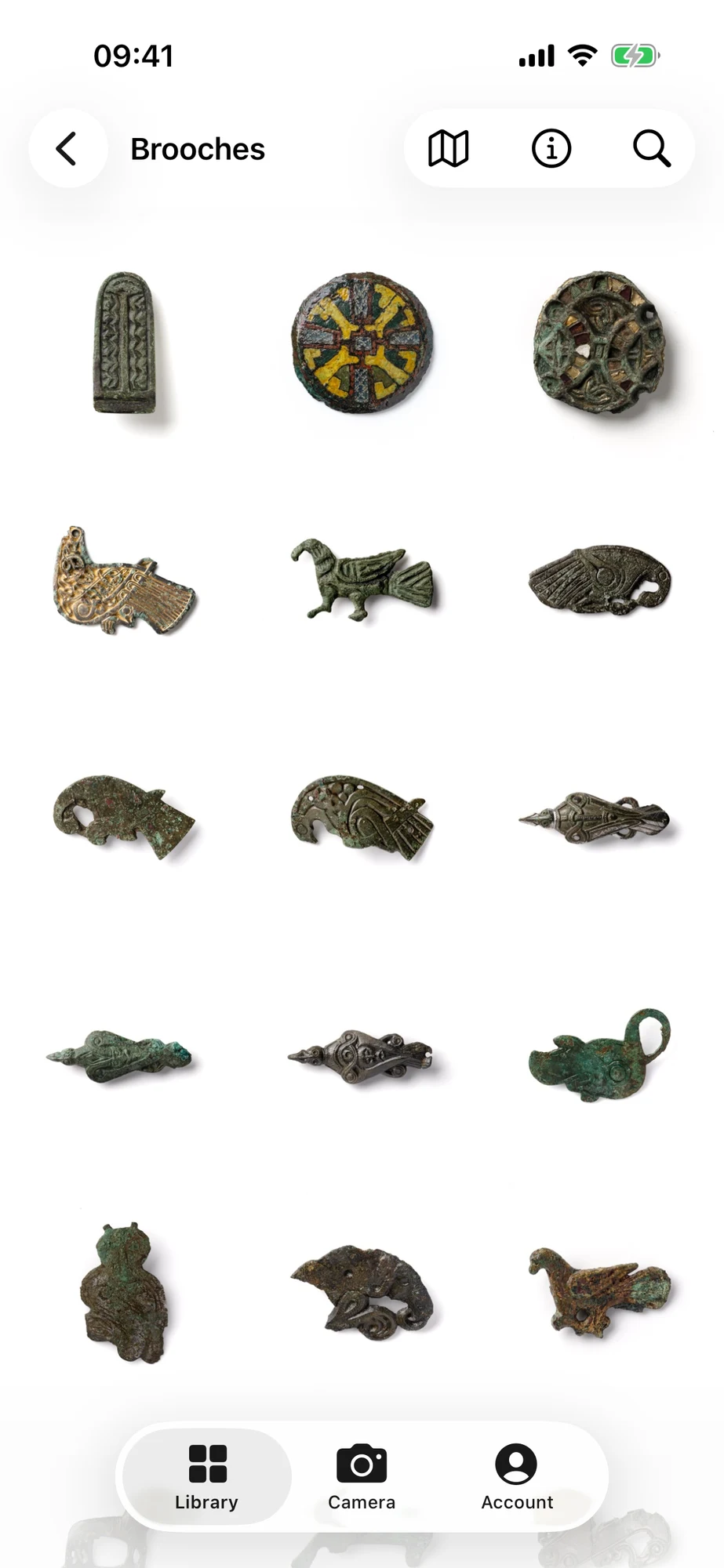
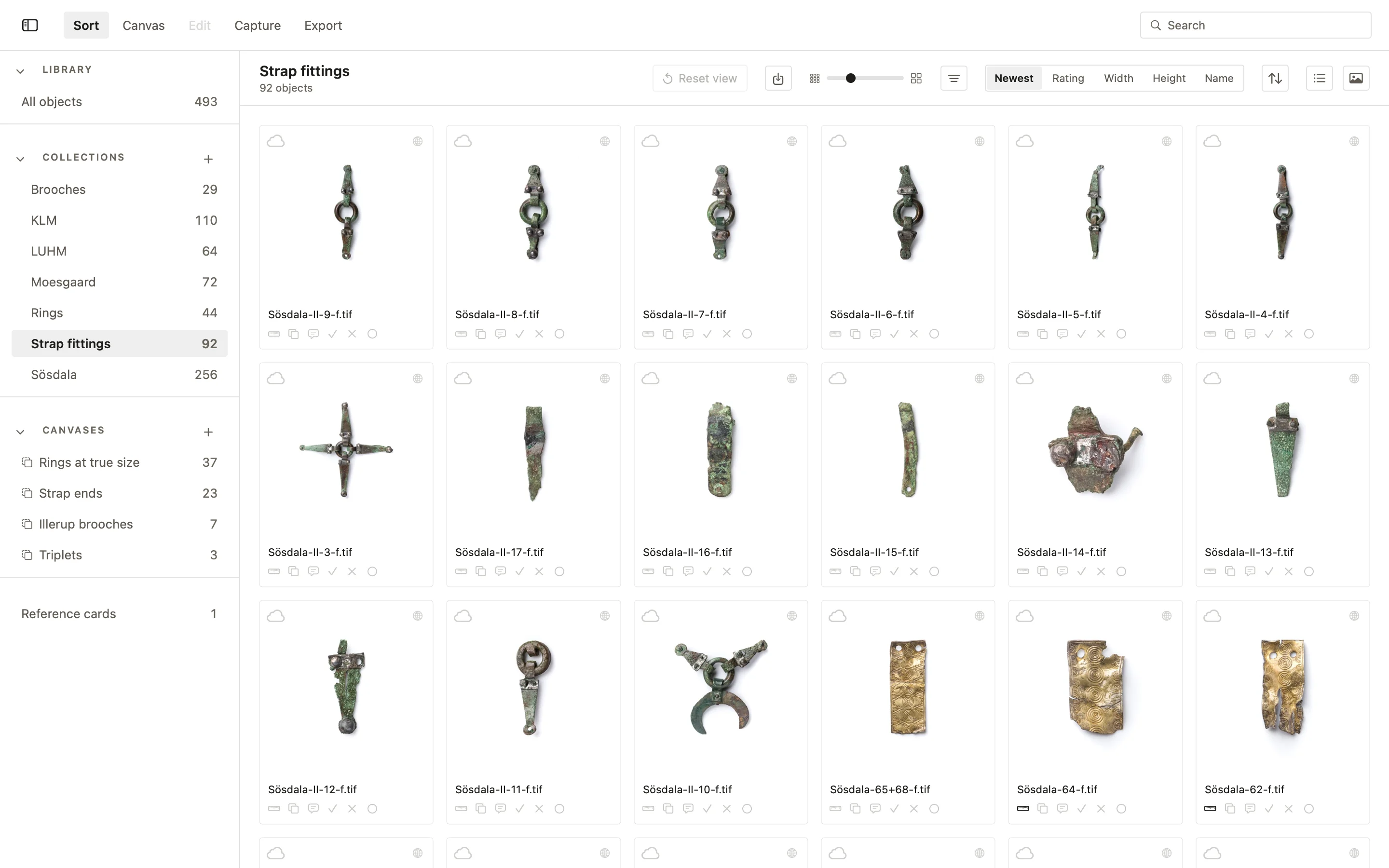
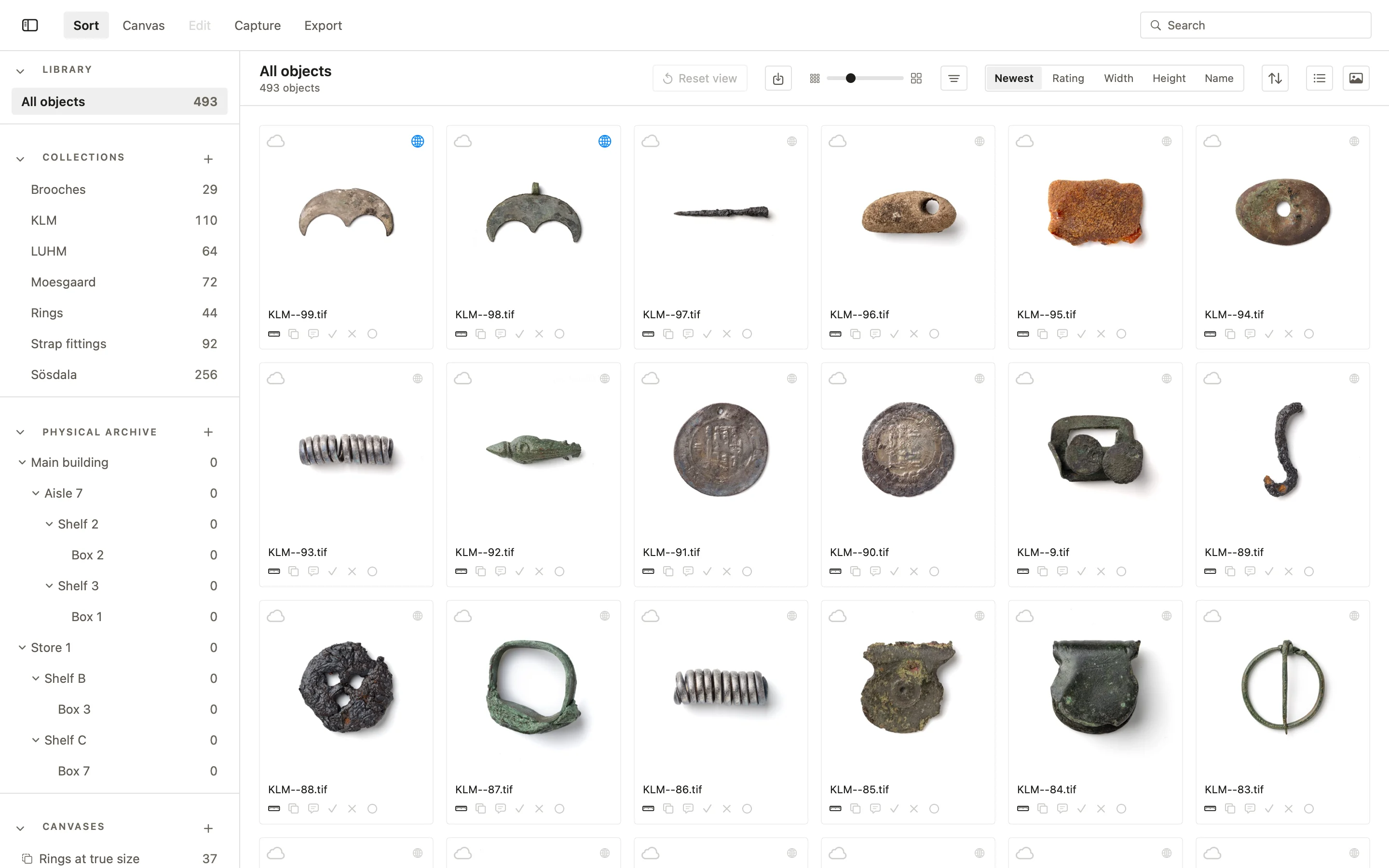
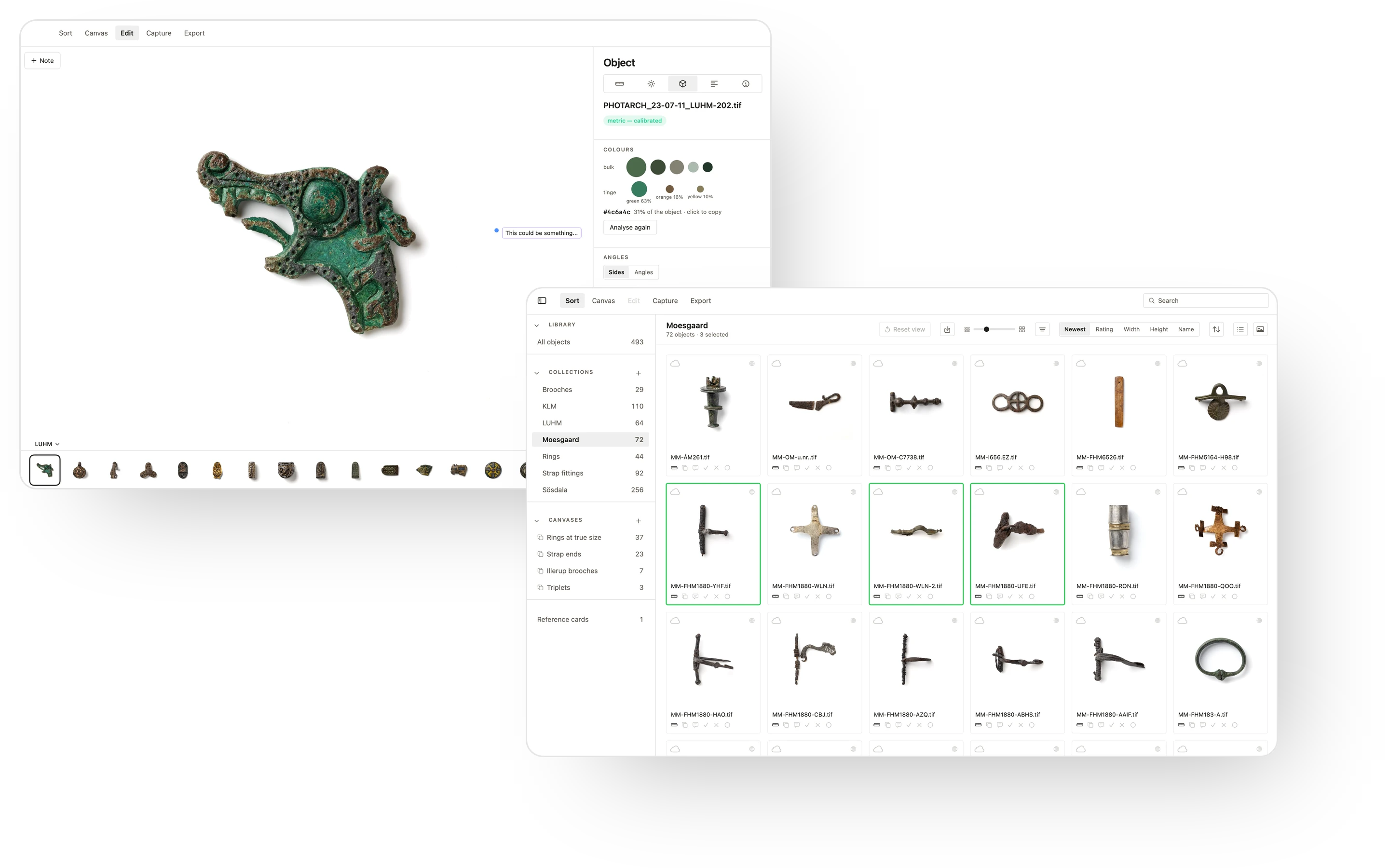
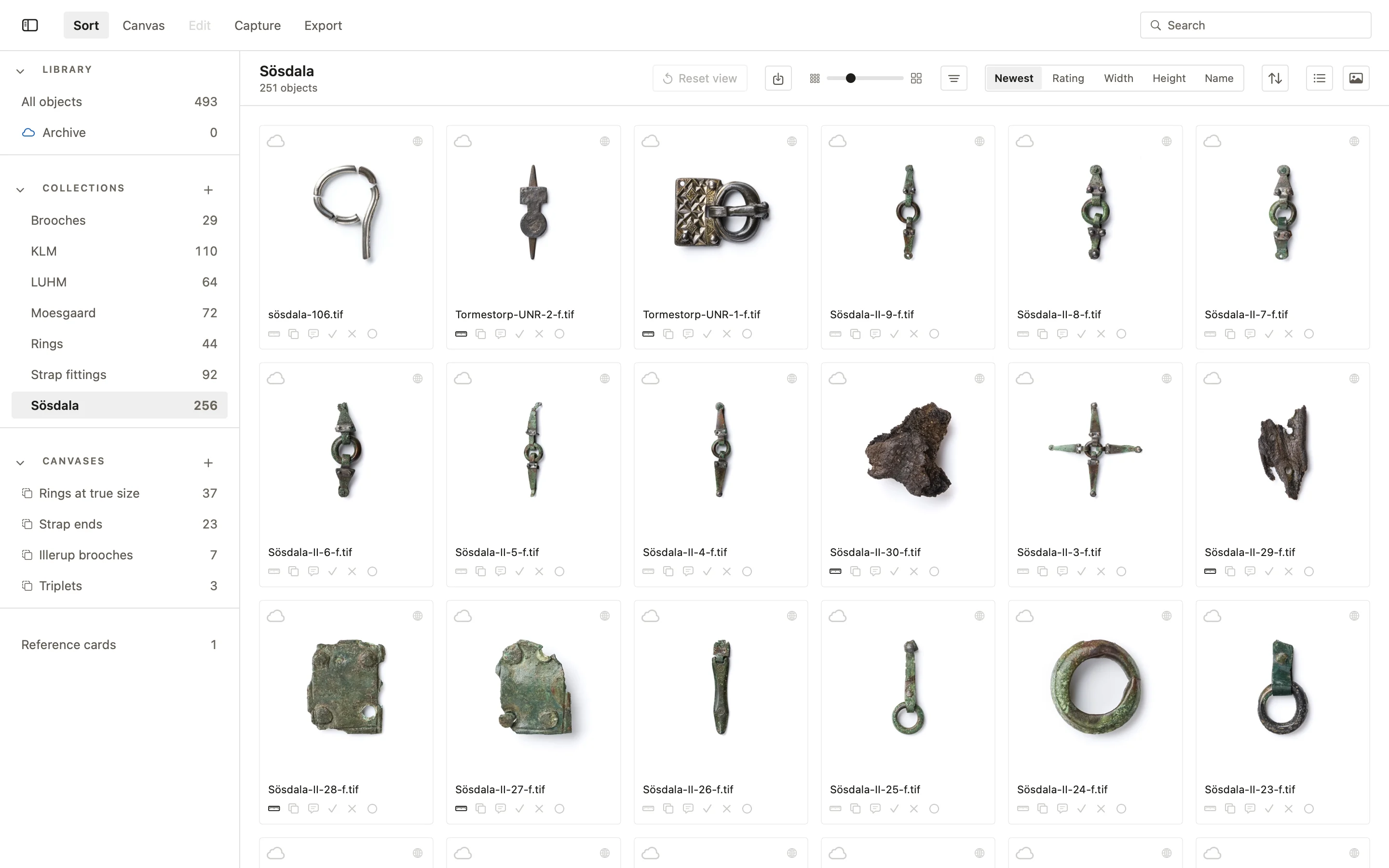
One app, from the shutter to the archive — the library on the Mac and the camera on iPhone.
Orders the objects by how much they look like one you choose, so similar objects end up side by side without a word being typed.
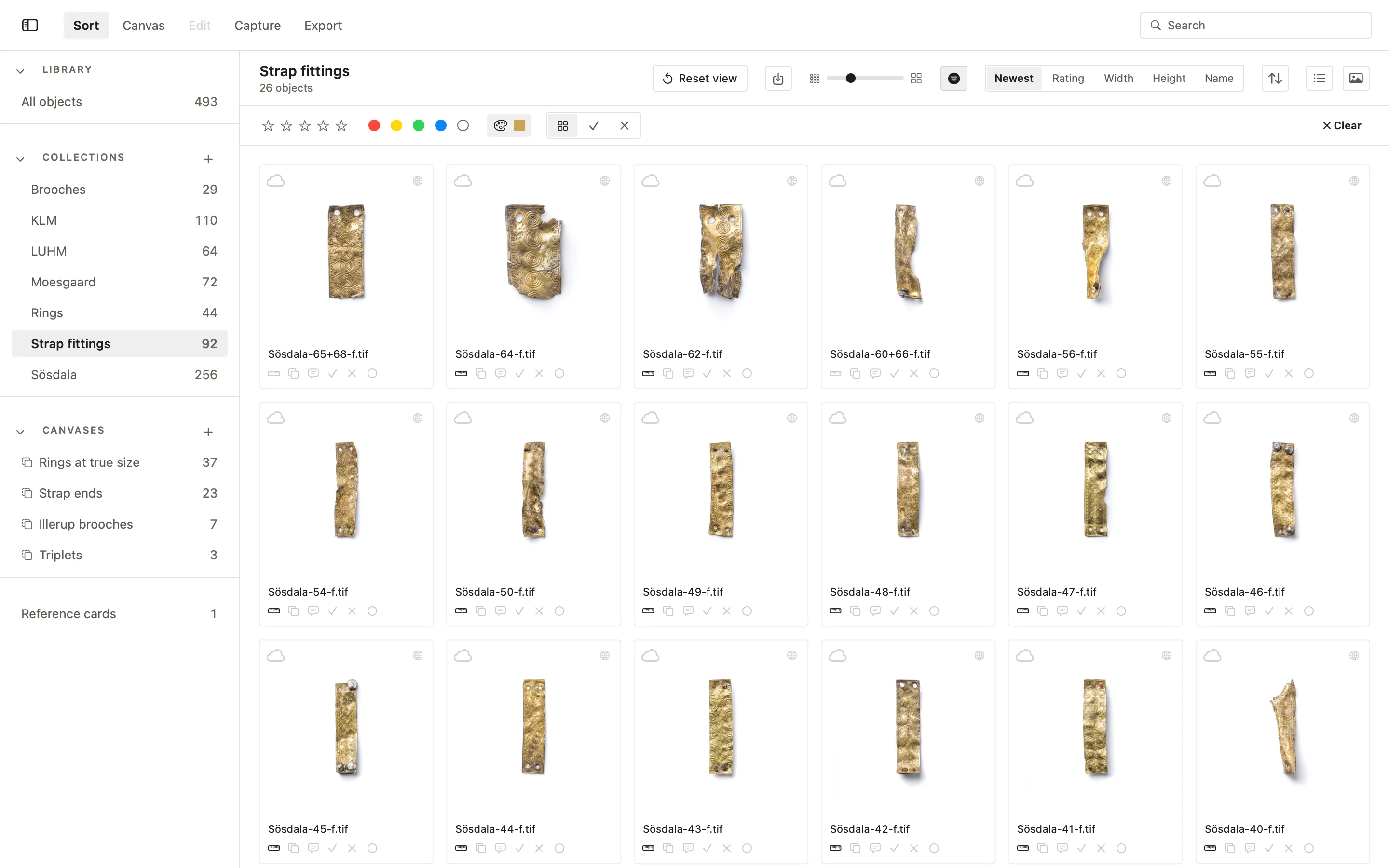
Pick a colour on the wheel and see every object that has it — the colours the object is mostly made of, measured, not guessed.
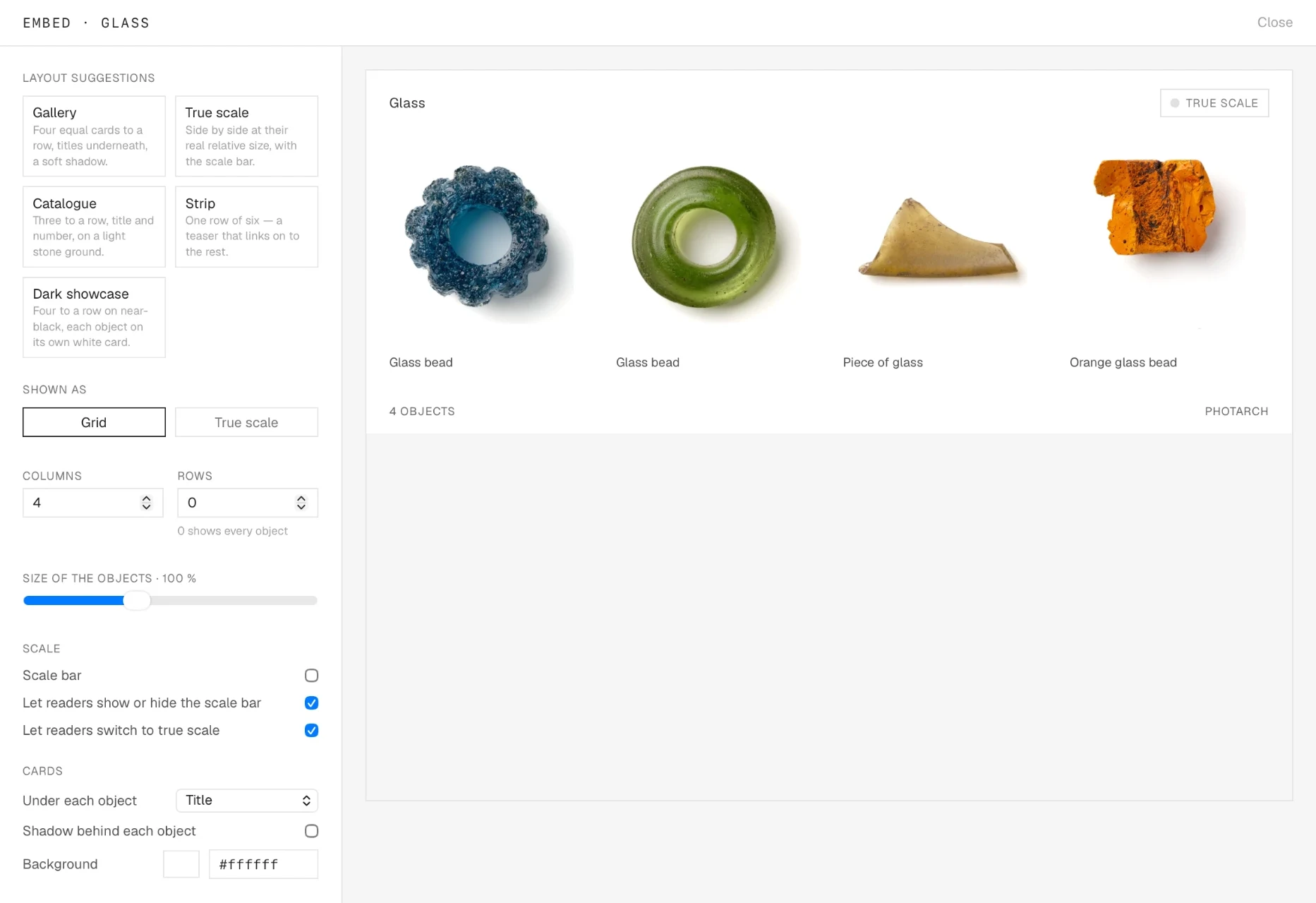
Objects shown at their true size relative to one another, with a scale bar.
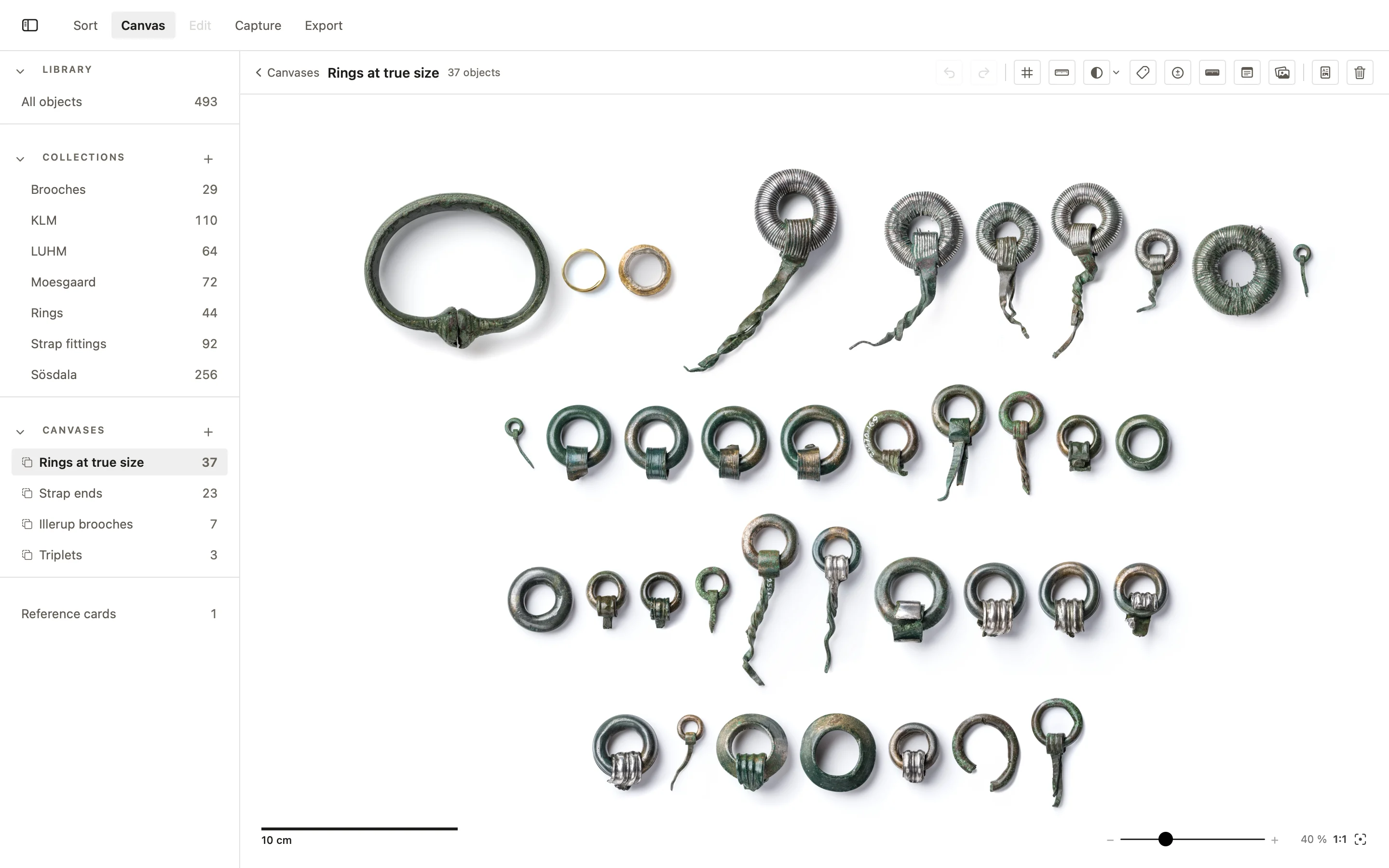
Lay objects out at their real size, turn them, annotate them, measure them and save the canvas as a PDF at true scale, to print or share.
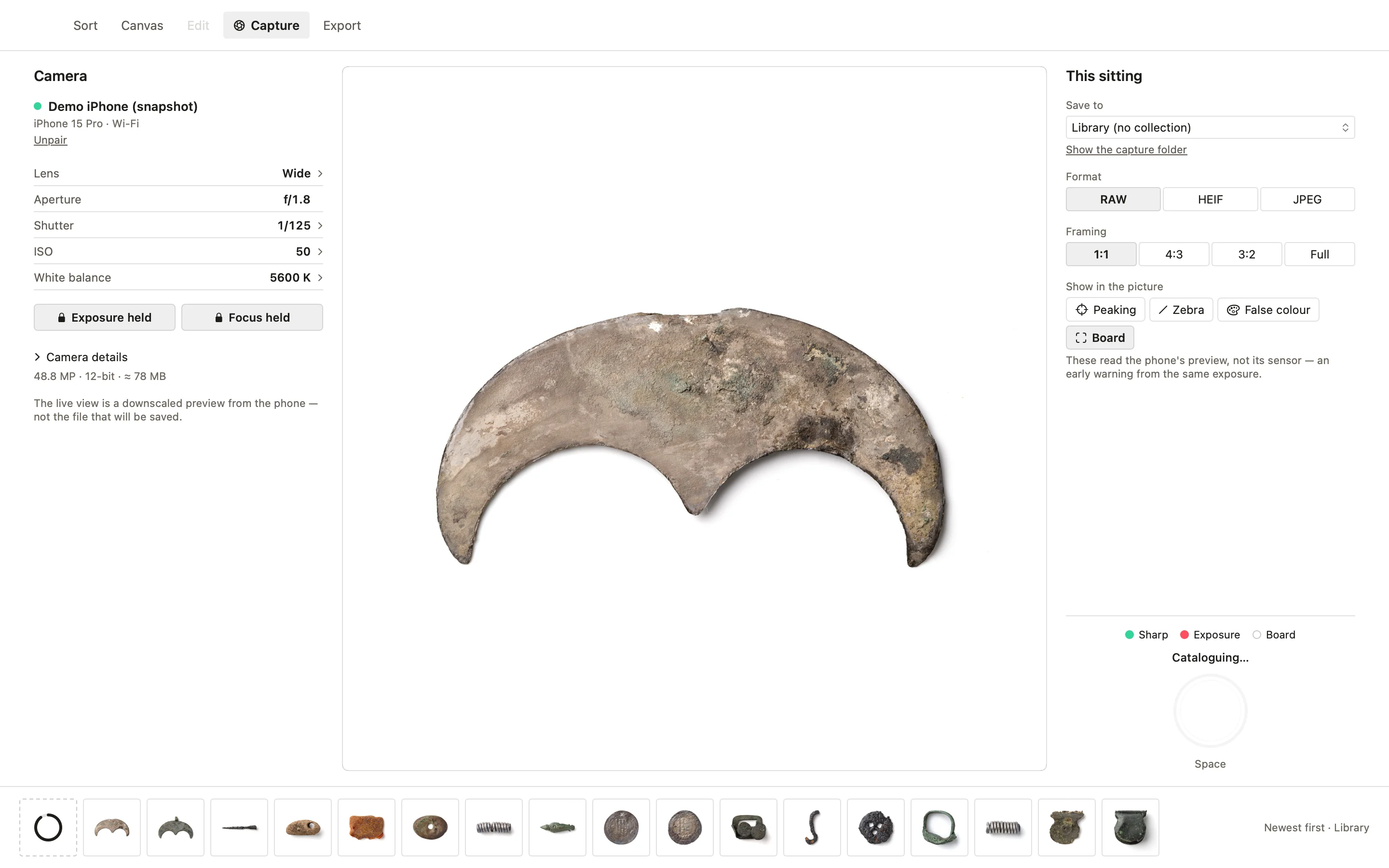
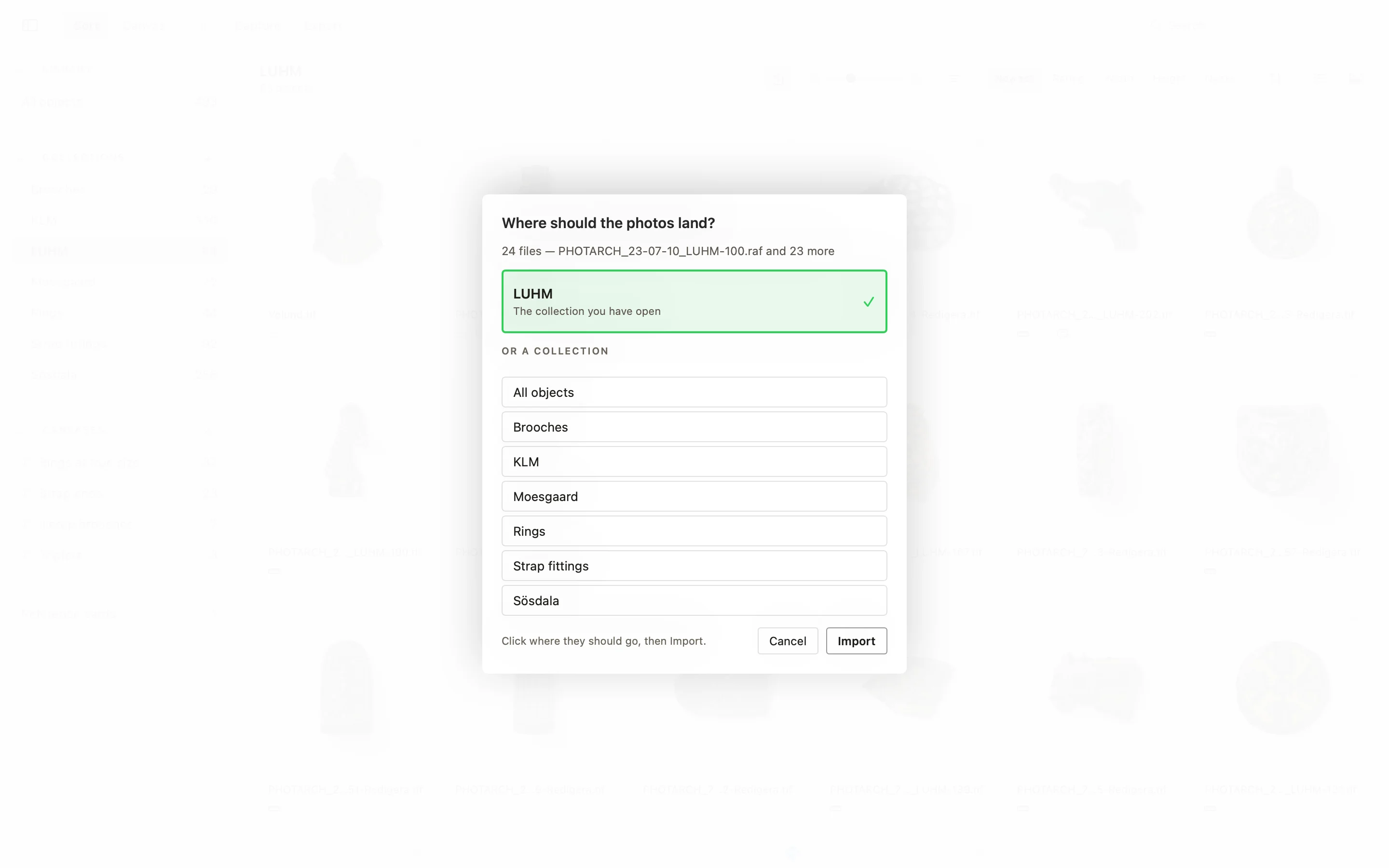
Shoot with PHOTARCH for iPhone, over Wi-Fi or a cable, straight into the catalogue — with exposure warnings and focus peaking in the viewfinder, and three lights, Sharp, Exposure and Board, that say whether the frame is worth taking. In an organisation, several photographers can photograph into the same library, one phone connected at a time.
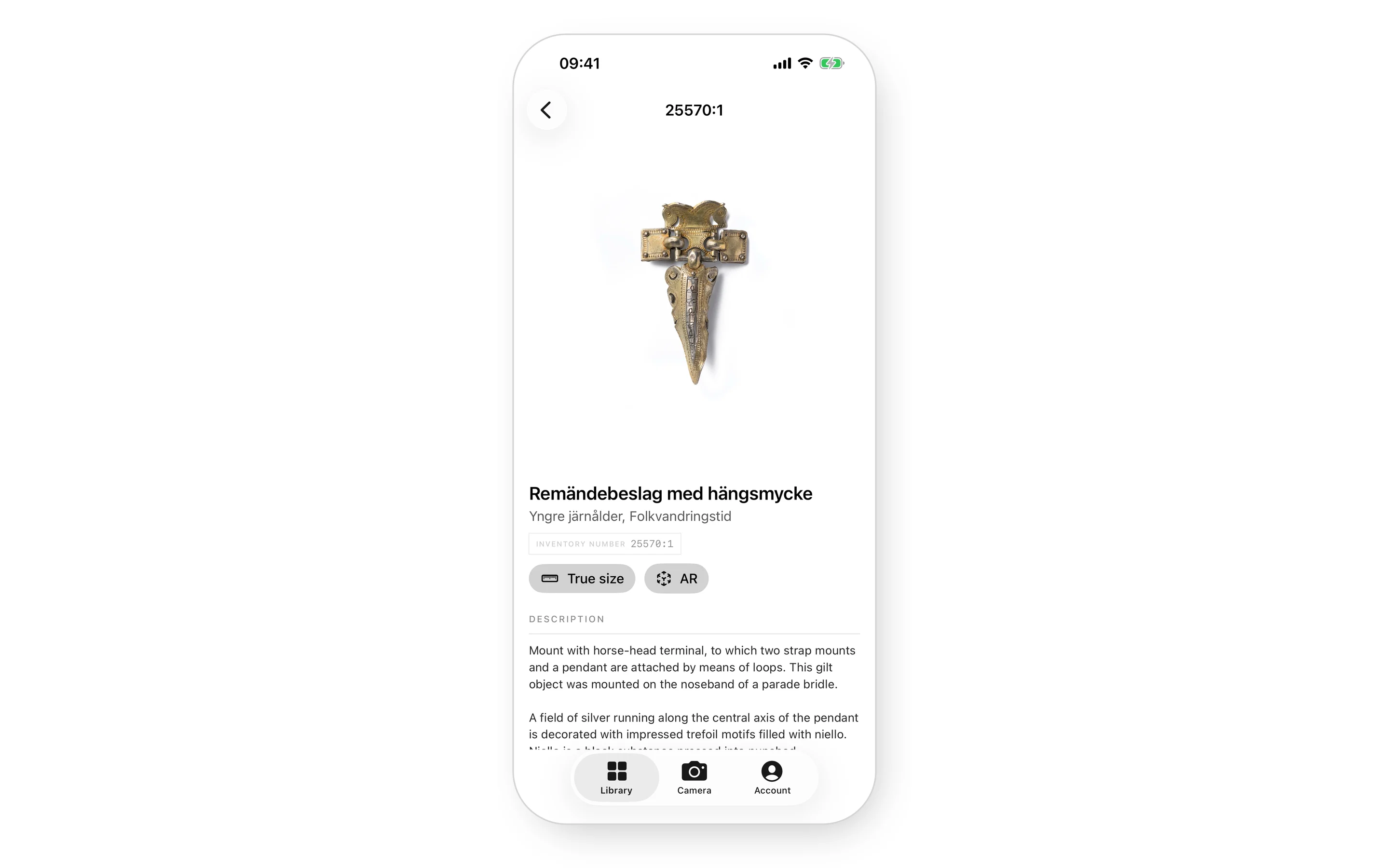
On iPhone (coming soon, pending App Store review), place an object in the room at its measured size and walk around it — or a whole canvas, laid out on a table as it was arranged.
An object that is broken can be handled two ways, and PHOTARCH supports both. Each piece can be an object in its own right, marked as a fragment. Several fragments can also be treated as one object — kept together, and shown together as one.
Select the pieces in Sort and choose Link as Fragments. They become one group, which can be shown as one card; put the pieces on a canvas and move them until they fit.
Try it: drag the three pieces together.
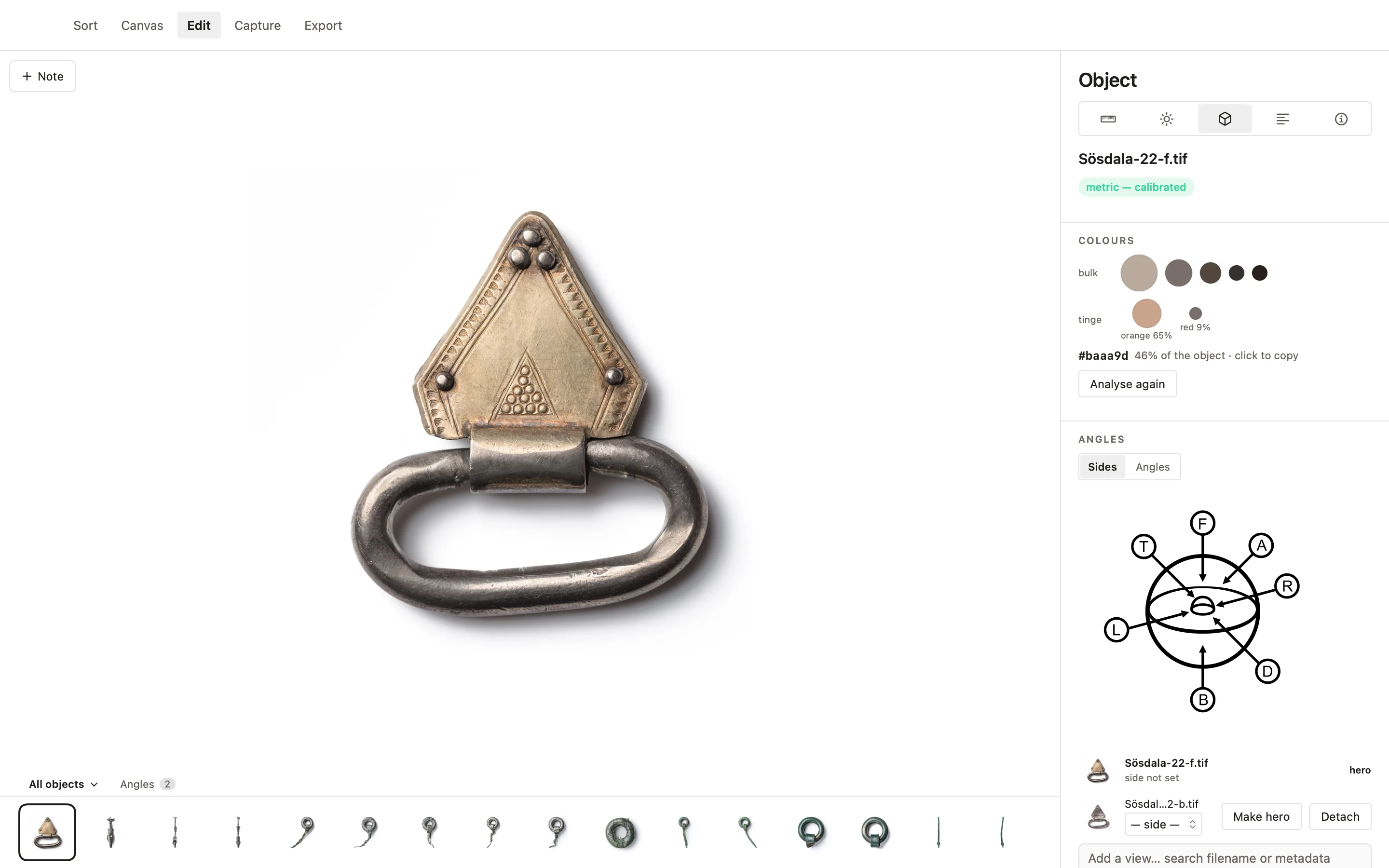
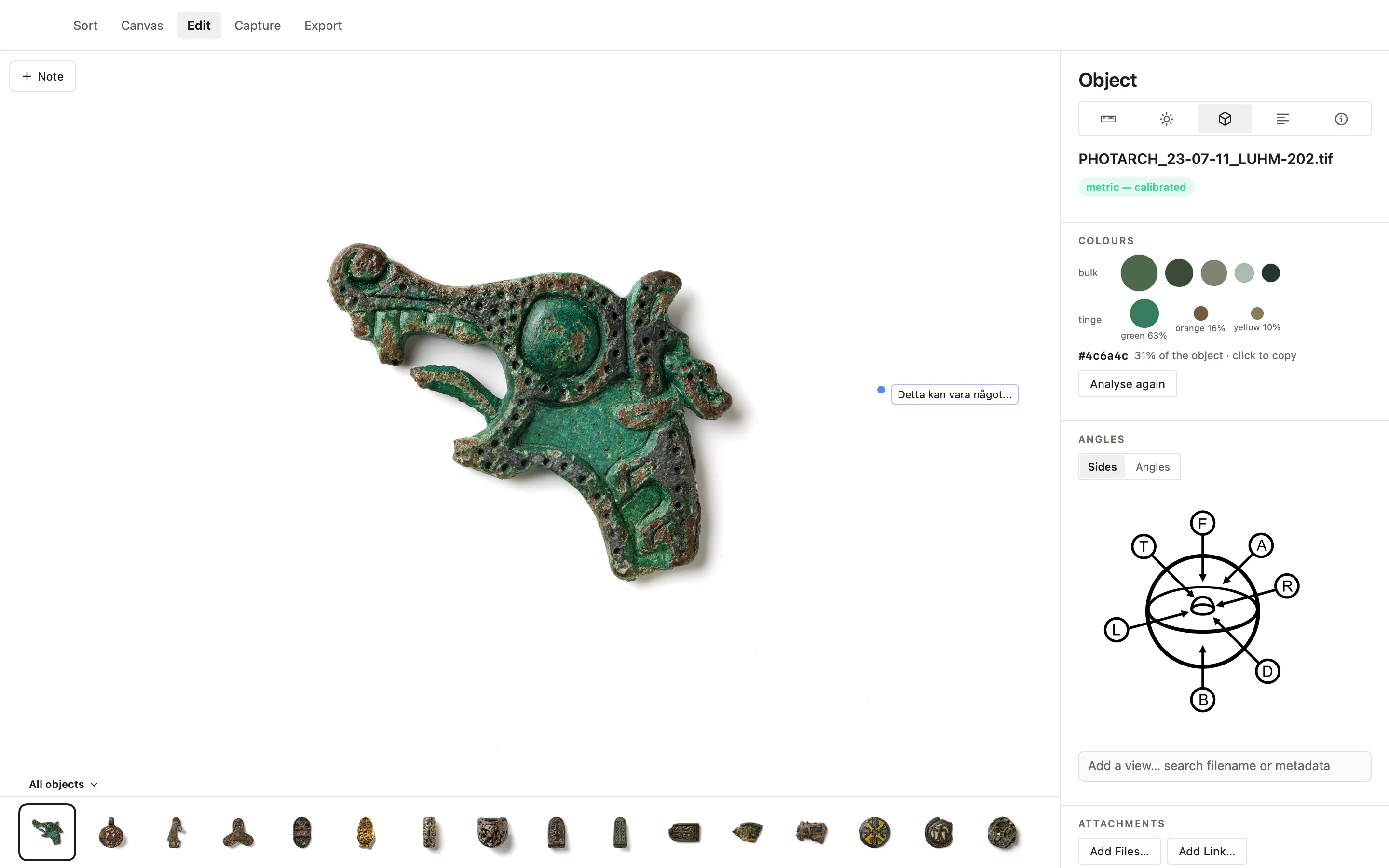
Every object has one main picture: the plumb view, taken straight down onto the object as it lies on the board. An object can also have other angles — its sides, its underside, a view from above at an angle — and they stay pictures of the same object, not objects of their own.
Each angle is named on a drawing rather than picked from a list: the sides on a sphere, the diagonals on a plan.
Try it: drag the sphere to turn it. Click a name, and its picture is marked; click a picture, and its name is.
Front — the upper face as it lies, from above: the main picture
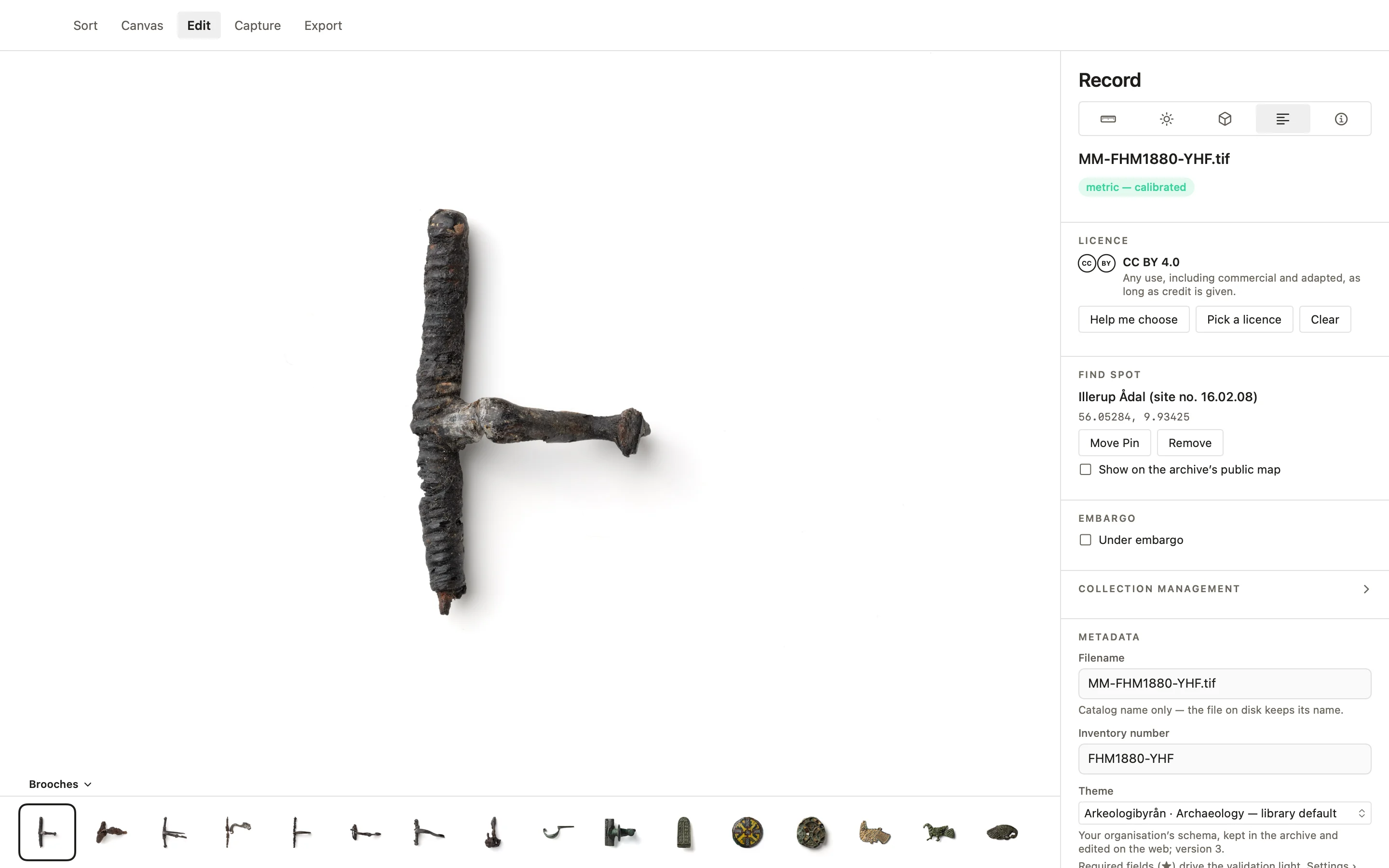
Anything that belongs beside the photograph travels with the object, and can be made public one by one.
Try it: this is a 3D model attached to an object. Drag to turn it.
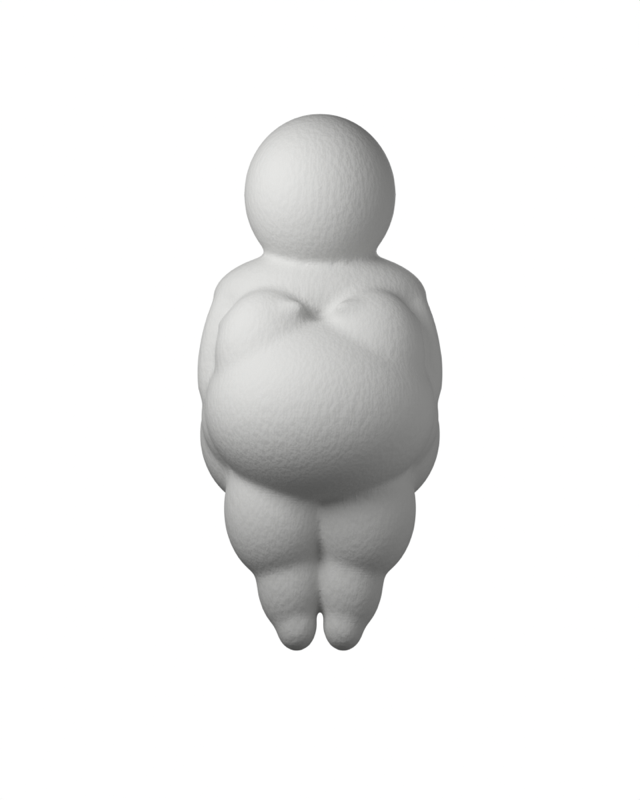
Loading the 3D viewer…
One app, from the shutter to the archive. Everything here is in every level, Free included, unless a row is marked Organisation only. Open a row to see it.
05 — AI admin · Organisation only
An organisation can let its own AI tool work on the library in the PHOTARCH app: search it, see what is missing, put records right, set licences, sort objects into collections and places, and publish to the archive.
The AI runs at your own AI service, on your own account and tokens.*
Your AI tool reads and changes the library through a connection that stays on the Mac. What the tool reads is processed by its provider under your own account with them, not by us.
Read everywhere; change only on the organisation’s cataloguing computer. It writes only the record’s own fields, a fixed list’s values from that list, and a licence from the fourteen statements the archive accepts.
Everything a session changed can be taken back at once while the app stays open: ask your tool to undo the session, or press Take Back … Changes in Settings › AI admin. A publication is taken back by withdrawing it.
* PHOTARCH runs no AI and pays for none; nothing is read or changed unless you ask your tool to. Works with Claude Desktop, added with one click from Settings › AI admin, and with other AI tools that run local MCP servers. ChatGPT reaches only servers on the internet, so it cannot use AI admin yet. The app has to be open while you work. Part of the organisation subscription.
06 — The organisation · Organisation only
Many researchers can work under one organisation. Notes can be shared with the whole organisation, and collections and canvases in the web archive by private link. Several can work on the same objects, each in a library of their own.
One computer holds the archive and catalogues into it; round it stand as many reading desktops as the organisation wants, each a researcher’s own library filled from the archive, which never writes to an original.
Give every shelf and box a small QR label. Point PHOTARCH for iPhone at it and see what is inside, move an object to another box on the spot, and have the move recorded in the object’s history.
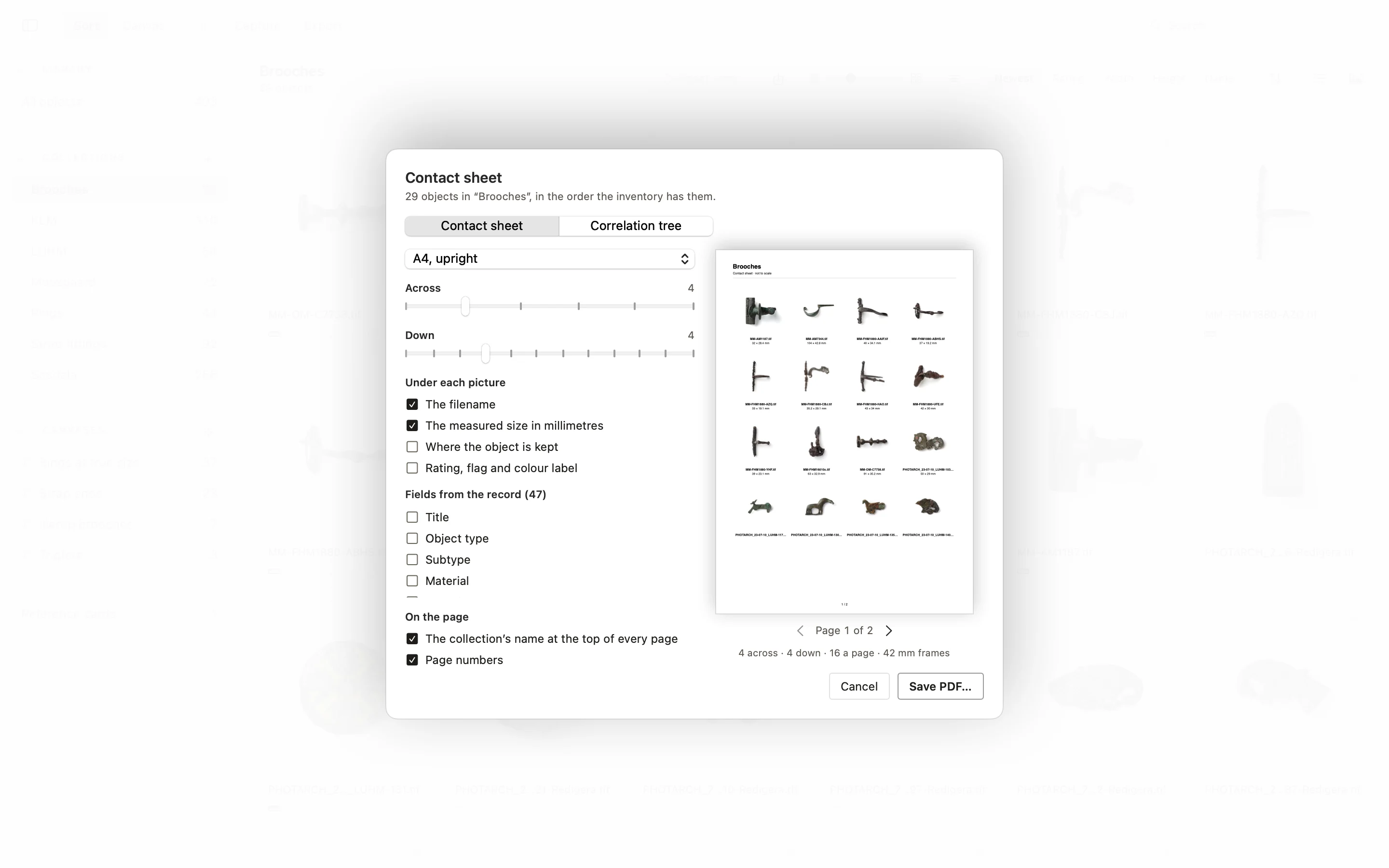
The objects of a collection or a place can be exported as a correlation tree: every place they are kept in, and the objects in each.

PHOTARCH for iPhone is the other half of the app. It is a camera of its own, free to download — and paired with the app on a Mac, over the local network or by cable, it becomes its shutter and live view: RAW, HEIF or JPEG, exposure warnings and focus peaking, and every picture straight into the library. In your pocket, the library goes with you, and an object — or a whole canvas — displayed through augmented reality.
iOS 17 or later. Works with every level of the app, Free included.
Pending release on
Download on theApp Store07 — Who it is for
The examples throughout PHOTARCH are archaeological, because that is where the method was built and proven. The principles themselves do not care what the object is — they care that the photograph can be trusted.
A holding photographed by one method can be compared, cited and published without being photographed again a decade from now. Shelf and location stay internal; what is published is what you choose.
Objects arrive in the record already measured, already identified, already ready to publish — and hold back anything that is not ready yet.
Material from several organisations becomes one dataset: same views, same light, same scale, same fields — and an address that still resolves in twenty years.
08 — Safety
Nothing here depends on this company being around, on a network being up, or on a subscription being paid.
The PHOTARCH app keeps images, catalogue, measurements and metadata locally: your photographs and records stay on your own computer, and none of them is uploaded in the background. An organisation can choose to share its store map — the places and what stands where — so every computer sees the same one; never the pictures, the records or a find spot. What reaches the public archive is what you send there, when you send it.
Every viewing version, tile and export is derived from the master, which is written once and left alone. A checksum is recorded when it enters, so the file you keep in ten years can be shown to be the file that came in.
A lapsed or unactivated licence falls back to the free tier. It always leaves your catalogue readable and your own data exportable — losing access to the software never means losing access to the work.
The licence is verified on the machine, not against a server, so the app runs in an archive with no signal and in the field with no network. Photographs taken without the computer queue on the phone and arrive when the two meet again.
Objects can be held back until they are ready to publish, and internal notes — shelf, location, accession number, condition — are never shown publicly.
The app sends no crash reports, and usage statistics are off unless you turn them on; they never include catalogue content, images or measurements. A data processing agreement is available for organisations that need one.
09 — Price
One app: the library on the Mac and the camera on iPhone. Every level carries the whole method — validation and measurement in millimetres. A private person buys the app once, as a tool; an organisation subscribes to the service around it — the archive, the team and the right to publish.
The app with every tool — the library on the Mac and the camera on iPhone — capped at one collection of 100 objects and one canvas. The web archive is open to everyone, without an account.
Private
Once · every v1 update included
100 €
The app without the cap, for one person. A tool you own: it runs on your own computer and phone, and nothing is kept on our servers. Bring in the photographs you have already taken — medium format, DSLR — and make them evidence.
Everything in Free, and
Organisation
Per month · invoiced yearly
100 €
Introductory price for the first year, for organisations that sign before 1 January 2027 (code INTRO2026); then 150 € per month
The app for as many photographers as the organisation has, all working into one archive — and the right to publish in the PHOTARCH web archive. One computer holds that archive and catalogues into it; round it stand as many reading desktops as the organisation wants, each a researcher’s own library filled from the archive, which never writes to an original. The organisation’s admin sets the rules for how everyone works with the material: which collection-management procedures are used, and how the store is laid out — row, shelf, box, object. The app follows them for every photographer.
Everything in Private, and
Free
0 €
The computer and the phone, capped at one collection of 100 objects.
Private
100 € once
The same app without the cap: your phone into your computer.
Organisation
150 € / month
One desktop holds the archive; the reading desktops stand round it, every photographer’s phone works into it — and from it, to the web.
Private is a personal licence, for one named person and their own devices. An organisation whose staff document its collection uses the organisation subscription. The camera app will be free on the App Store, and it photographs on its own; paired with the app on a Mac — the free level included — it becomes its shutter and live view, and the pictures land straight in the library.
Prices exclude VAT. A Private licence can be refunded within 14 days — refunds and cancellation.
10 — The details
Pictures in the forms archives keep, and records in the formats collection systems import. The original is never touched: every export is made from it, and the same object gives the same file every time.
Free
Pictures of objects brought in on Free carry a small “Processed by PHOTARCH” mark.
Private
The same pictures, unmarked — and the record on its own:
Organisation
Everything in Private, and the formats organisations exchange:
Every picture PHOTARCH writes holds its own information, written into the file itself, at every level. It travels with the picture wherever it is copied, and other software can read it — nothing has to be looked up in PHOTARCH. The original in a package is kept byte for byte, with the record in a file beside it.
PHOTARCH follows established standards where they exist and extends them where the photographic dimension is not addressed. The goal is interoperability — records that can leave the archive and work elsewhere.
Rights statements
ActiveEvery image carries one of the fourteen rights statements Europeana accepts — a Creative Commons licence, the Public Domain Mark or a RightsStatements.org statement — with its URI in the IIIF manifest and the LIDO record.
TIFF / JPEG
ActiveTIFF as master format, JPEG as delivery derivative. Resolution and colour space requirements set by the PHOTARCH method.
EXIF / IPTC
ActiveThe master is kept exactly as it arrived, camera metadata included. The record, the scale and the rights are written into every copy that is downloaded or exported.
Dublin Core
ActiveCore descriptive fields (title, type, date, creator, rights) mapped to Dublin Core elements in all records.
LIDO
ActiveLightweight Information Describing Objects. XML export per object for aggregation with museum network portals.
ARK / NAAN
ActiveArchival Resource Keys with registered Name Assigning Authority Number. Persistent, resolvable identifiers for every object record.
SHA-256 checksums
ActiveA cryptographic checksum on every master file in the archive. Enables verification of the master’s integrity over time.
IIIF
ActiveInternational Image Interoperability Framework. Every published image is served through the IIIF Image API 3 — deep zoom to the master’s full resolution — with a IIIF Presentation 3 manifest per object for external viewers and platforms.
What it is and how to use it →CIDOC-CRM
ActiveConceptual Reference Model for cultural heritage (ISO 21127). Every published object is also a Linked Art record — CIDOC-CRM as JSON-LD — with its dimensions, production, find context and photographs, and materials, object types, periods and techniques linked to the Getty Art & Architecture Thesaurus.
Europeana EDM
ActiveEuropeana Data Model. Organisations export EDM records from the PHOTARCH app, written to Europeana’s own schema and rules. Delivery to Europeana goes through a national or domain aggregator.
C2PA
ActiveCoalition for Content Provenance and Authenticity. Every published picture and every download carries a signed record of how it was made and the scale it holds, countersigned by an independent timestamp authority. Answers the question: can this image be trusted?
What it is and how to use it →ISO 19264-1
For flat originals
Imaging systems quality analysis for reflective originals: measures a camera or scanner on a test target — tone, colour, resolution, noise, uniformity — in levels A, B and C. The PHOTARCH app assesses objects by its own levels; for paintings, documents and other flat originals it turns this standard on, with FADGI and Metamorfoze, reads the level through FADGI’s correspondence on what it can measure, and names what it cannot. It is not a certification.
What it is and how to use it →A museum with a collection system of its own gets exports it can import. For a smaller museum, a society, a research project or an excavation archive without one, the app can be the collection system itself: the record, where each object is kept, and everything that happens to it — on the organisation’s own computers. The organisation can choose to share its store map — the places and what stands where — so every computer sees the same one; never the pictures, the records or a find spot.
Controlled vocabularies, the organisation’s own fields, fragments and angles, notes and attachments — and rights and embargo per object.
Shelf, location and accession number, kept inside the organisation — never published.
Intake, acquisition, location and movements, inventory checks, condition, conservation, loans out and in, valuation and insurance, damage and loss, use and reproduction, deaccession — each a dated entry, as often as it happens.
An entry is written for a whole selection at once — a move of a box, a condition check of a drawer.
The organisation’s admin sets how everyone works with the material: which procedures are used, and how the store is laid out — row, shelf, box, object. The app follows them for every photographer.
Taking part in the public archive is never required. The app does the whole job without it; publishing is there for the organisation that wants its collections seen.
One app with two places to work: the library on the Mac and the camera on iPhone. That is where a collection is photographed, measured, described and packaged. The photographs and records stay on the organisation’s own computers. The organisation can choose to share its store map — the places and what stands where — so every computer sees the same one; never the pictures, the records or a find spot.
A public archive on the web, made for access: a visually driven database where anyone can browse, compare and cite what organisations have chosen to publish.
Nothing is uploaded automatically. An organisation that wants its collections to be accessible sends them, object by object, and keeps them in step when it chooses. An add-on, not a requirement.
PHOTARCH is built for Apple hardware and nothing else. That is a choice, not a gap: a method that measures colour and scale needs a controlled screen and a predictable colour pipeline, and controlling the whole chain is what makes the measurements worth trusting.
On the Mac
On iPhone
To learn the method and to use what is already in the archive are free of charge. The software is for the organisations that want to document their objects that way themselves.