Collab: work on a collection with colleagues, in the PHOTARCH app
Objects are rarely studied by one person alone. A curator asks a specialist at another museum about a brooch, a researcher compares a find group with a collection three countries away, a conservator and a registrar work on the same records. Today that work travels by email: pictures without their scale, records copied into documents that drift apart, and material that cannot be shown at all until it is published.
From 9 November 2026 the PHOTARCH app has Collab: a collection or a canvas from the app's library can be shared with colleagues, who work on it in their own PHOTARCH app.
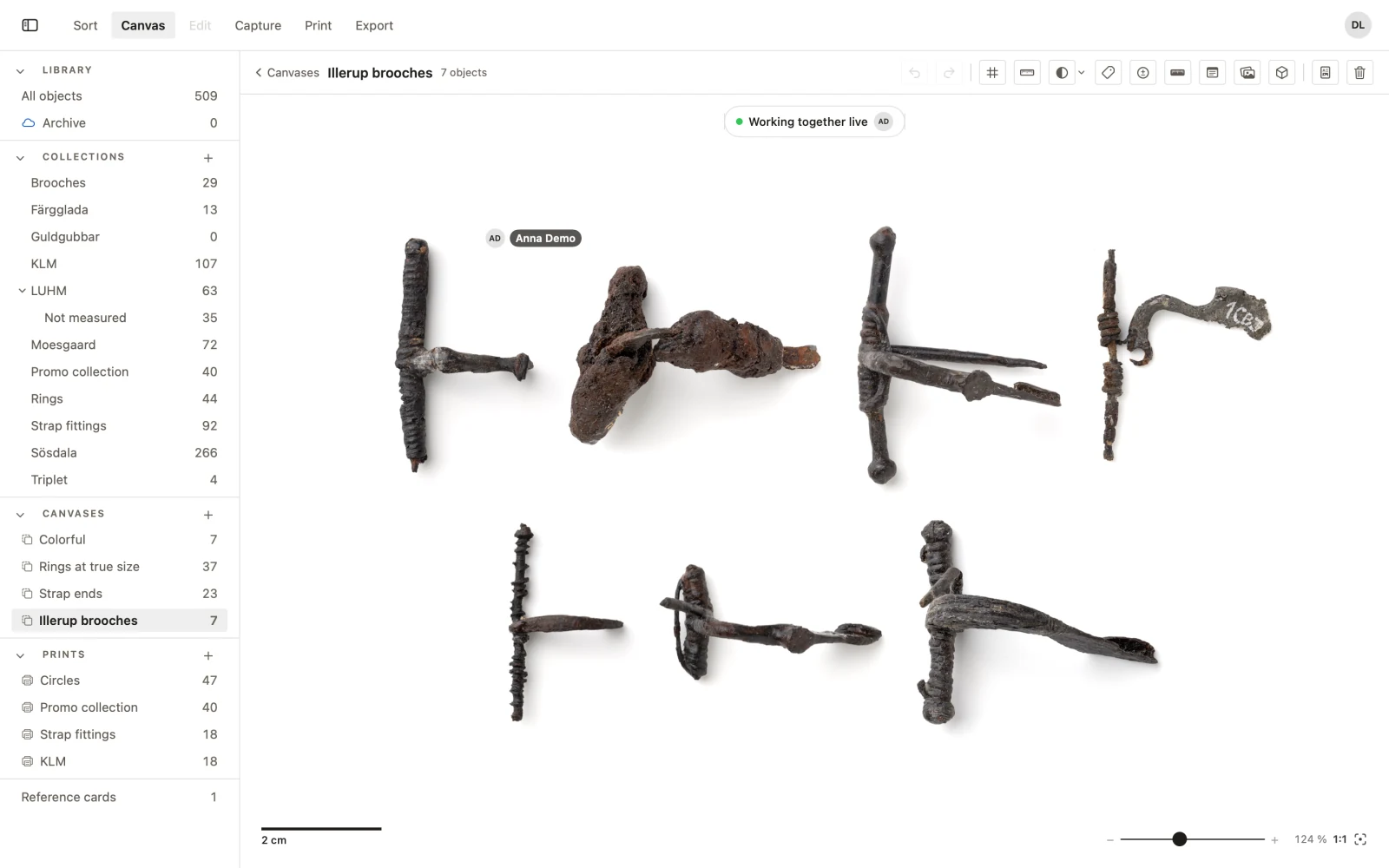
One method, one table
A photograph taken to the PHOTARCH method carries its scale and its record in the file. That is what makes Collab more than sending pictures: a colleague reads the same millimetres, lays the same objects side by side at their true sizes, and edits the same record, as if both stood at one table.
What a colleague changes in a shared collection comes back as suggestions, field by field: the value now beside the one suggested, to accept or decline. Nothing reaches the collection until its owner accepts it, and each accepted change is noted in the object's documentation with the colleague's name.
A canvas can be shared the same way, with a choice for each share: take turns, where every move comes as a suggestion, or work together, live, where both move objects at once and see where the other is working.
Sealed, and chosen part by part
A shared collection is sealed on the owner's Mac, end to end, for the people invited and no one else; PHOTARCH relays it without being able to read it. Each part of the record is chosen when sharing: the record, the measurements, notes and attachments go by default, find spots and storage places stay home unless they are ticked. What is not ticked never leaves the Mac. Shares last 7 days, 30 days, a year or until closed, and the colleagues' copies disappear when a share ends.
Sharing needs a Private licence, or write access in an organisation with a licence. A colleague who is invited needs only a PHOTARCH account and the app on a Mac.
How it works, step by step and with pictures, is in the manual: Collab: working on a collection with colleagues and Collab on a canvas. More about the app at app.photarch.com.